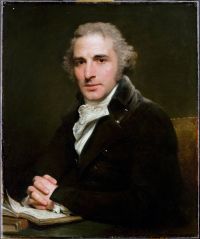
John Philip Kemble

John Philip Kemble

Summary

Portrait of John Philip Kemble John Philip Kemble Macbeth, and King Richard the Third (1817)

Ambition is the sole impulse that directs every action of Richard's life: his heart, in which every malignant and violent passion reigns uncontrolled, is hardened in wickedness: his mind is sunk into that depth of hopeless depravity, where the bad believe all other men to be as abandoned as themselves: he attains the crown by hypocrisy habitual to him, and by murders, that entail no remorse on the stern valour with which he maintains his ill-acquired sovereignty. Ambition is implanted in the nature of Macbeth; but it is a blameless ambition
Source: Wikisource

Portrait of John Philip Kemble John Philip Kemble Macbeth, and King Richard the Third (1817)

This is the valour, to which Macbeth's claim can never justly be disputed.
Mr. Whateley and Mr. Steevens have entirely overlooked the essential difference there is betweeq the fear of doing wrong, and the fear of external harm,—between the blind animal ferocity that goads the brute, and the noble motive that inspires the rational intrepidity of man: Here is the cause of the mistakes they have committed; and indeed it has led them so far into error, that they almost expose themselves to be accused of maintaining, that courage and virtue are never inmates of the same breast.
Source: Wikisource

Portrait of John Philip Kemble John Philip Kemble Macbeth, and King Richard the Third (1817)

Is it, then, to betray fear in enterprise,—already worn with the toils, and weakened by the losses, of a hard-fought, well-won field,—to rush, at disadvantage, on fresh and frightful numbers, with unconcern like that which eagles and lions might be conceived to show, if opposed to hares and sparrows? While Macbeth thus dedicates himself to the face of peril, does his behaviour indicate reluctance?
Source: Wikisource

Get perspective with Kwize: daily news enlightened by great literature