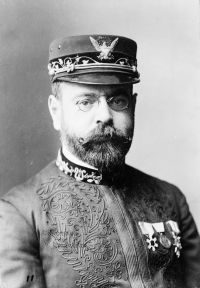
John Philip Sousa

John Philip Sousa

Summary

Portrait of John Philip Sousa John Philip Sousa,  Fifth String (1902)

“ And she, with imagination greater than reasoning power, at once saw a Tuscan beauty and Diotti mutually pledging their love with their lives.
"Go," she said, pointing to the door, "go to the one who owns you, body and soul; then say that a foolish woman threw her heart at your feet and that you scorned it!" She sank to the sofa.
He went toward the door, and in a voice that sounded like the echo of despair, protested: "Mildred, I love you; love you a thousand times more than I do my life. If I should destroy the string, as you ask, love and hope would leave me forevermore.
”
Source: Wikisource

Portrait of John Philip Sousa John Philip Sousa,  Fifth String (1902)

“ Tears welled from the poor violinist's eyes as he gazed on the fragments of his beloved violin, the pieces lying scattered about as the result of his unfortunate anger.
"It was a Stradivarius," said Diotti, sadly.
"Had it been a Stradivarius, an Amati or a Guarnerius, or a host of others rolled into one, you would not have found in it the melody to win the heart of the woman you love. Get a better and more suitable instrument."
"Where is one?" earnestly interrogated Diotti, vaguely realizing that Satan knew.
"In my possession," Satan replied.
”
Source: Wikisource

Portrait of John Philip Sousa John Philip Sousa,  Fifth String (1902)

“ When we realize all the misery there is in this world we often wonder why we should care to live." Her tone was despondent, her face was drawn and blanched, and her eyes gave evidence of weeping.
Diotti divined that something beyond sympathy for old Sanders' sudden death racked her soul. He went toward her and lovingly taking her hands, bent low and pressed his lips to them; they were cold as marble.
"Darling," he said; "something has made you unhappy. What is it?"
"Tell me, Angelo, and truly; is your violin like other violins?"
”
Source: Wikisource

Get perspective with Kwize: daily news enlightened by great literature