Summary

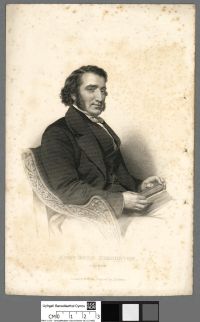
Portrait of John Stoughton John Stoughton Recollections of a Long Life

My personal recollections of Methodism, which roll back more than seventy years ago, linger round Yarmouth and Norwich. At Yarmouth I used to worship on a Sunday in a curious old-fashioned square chapel, with galleries on the four sides. There was a deep one opposite the two entrance doors, and attached to the front of that gallery was a pulpit—by what means, as a boy, I never could make out. The preacher ascended from behind by a staircase, invisible to the congregation, and then from the top of the staircase descended by two or three steps into a curiously shaped pulpit.
Source: Gutenberg

Portrait of John Stoughton John Stoughton Recollections of a Long Life

I have a great delight in all genuine Christian union, but my conception of it is by no means confined to the cultivation of love and sympathy with those, who in all, or in most, respects concur with me. There is an admirable passage in Julius Hare’s preface to the third volume of Arnold’s “Rome.” “We are so bound and shackled, by all manner of prejudices, national, party, ecclesiastical, individual, that we can hardly move a limb freely; and we are so fenced and penned in, that few can look over their neighbour’s land, or up to any piece of sky, except to that which is just over their heads.”
Source: Gutenberg

Portrait of John Stoughton John Stoughton Recollections of a Long Life

What a contrast between two poets, whose memories came vividly before me during this tour!—Byron and Scott, both of them lame for life; one a stranger to the other’s purity. Years afterwards I heard Dean Stanley preach a sermon to children, in which, with his characteristic felicity of thought, he spoke of the contrasted influences of physical deformity in these two instances—how the club foot of the first was an occasion of mortified pride and ill-nature, and the club foot of the second was borne with patience and contentment.
Source: Gutenberg

Get perspective with Kwize: daily news enlightened by great literature