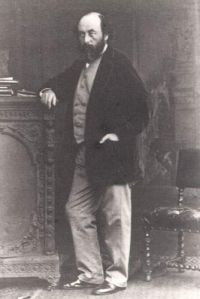
Joseph Beete Jukes

Joseph Beete Jukes

Summary

Portrait of Joseph Beete Jukes Joseph Beete Jukes The South Staffordshire Coalfield… (1859)

The Drift gravel that more or less covers the country is in a great measure derived from the waste of this conglomerate, and without practice it is at first, sometimes, very difficult to distinguish between these ancient gravels of the New red sandstone period and the other gravels that belong to the much more modern period in which "the Drift" was formed.
Source: Wikisource

Portrait of Joseph Beete Jukes Joseph Beete Jukes The South Staffordshire Coalfield… (1859)

BUNTER—The Upper Red and Mottled Sandstone.—The Upper Red and Mottled sandstone round the South Staffordshire Coal-field invariably succeeds, in descending order, the strata described above. It varies in thickness from 400 to 500 feet, and generally consists of fine bright red sand, sometimes streaked and mottled with yellow. These sands are often false bedded, but they never contain pebbles. On the east side of the Coal-field this sub-formation ranges from the neighbourhood of Harborne by Birmingham to Sutton Coldfield, and again from the southern part of Cannock Chase eastward to Shenstone.
Source: Wikisource

Portrait of Joseph Beete Jukes Joseph Beete Jukes The South Staffordshire Coalfield… (1859)

The conglomerate is generally more or less incoherent, but occasionally it is cemented into hardish rock by the presence of carbonate of lime. In general, however, it still so completely retains its original character of gravel, that it may be dug out with the pickaxe and shovel, and is used for gravel pits. Occasionally it consists chiefly of sand, with only a few scattered quartz pebbles, as, for instance, in the small patch between Northfield and Frankly.
Source: Wikisource

Get perspective with Kwize: daily news enlightened by great literature