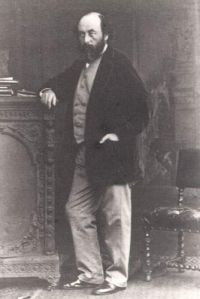
Joseph Beete Jukes

Joseph Beete Jukes

Summary

Portrait of Joseph Beete Jukes Joseph Beete Jukes The South Staffordshire Coalfield… (1859)

The country about the Lickey and Clent Hills.—The south end of the Lickey Hill, that on which the obelisk stands, is composed of the quartzose conglomerates and red sandstone, believed to be there the base of the New red. On the northern end of the Lickey, about Square Coppice, as also on all the summits of the high ground of Segban, Romsley, Frankley Beeches, and the higher parts of the Clent Hills, where we get what appear to be the highest of the Permian beds in their respective localities, we find these beds to consist of a remarkable trappean breccia.
Source: Wikisource

Portrait of Joseph Beete Jukes Joseph Beete Jukes The South Staffordshire Coalfield… (1859)

The reader must be pleased to bear in mind, that these descriptions of the Permian and New red sandstone rocks are meant to apply solely to the district of the South Staffordshire coal-field and its immediate neighbourhood. The Permian rocks of the neighbourhood are believed to be variable, both in lithological character and in thickness, with perhaps many frequently recurring characteristics, but no uniformity. The thickness of the formation is believed to vary almost indefinitely within the limits of 1,000 or 3,000 feet.
Source: Wikisource

Portrait of Joseph Beete Jukes Joseph Beete Jukes The South Staffordshire Coalfield… (1859)

This is more especially true with respect to the second or Waterstone subdivision of the New red sandstone, the dark brown or pale red sandstones of which, with their interstratified marls and calcareous bands, are scarcely distinguishable by any lithological characters from similar beds in the Permian formation. There are, however, we believe, no brick-red sandstones like that of the Bunter, and scarcely any quartzose conglomerate to be found in the Permian formation
Source: Wikisource

Get perspective with Kwize: daily news enlightened by great literature