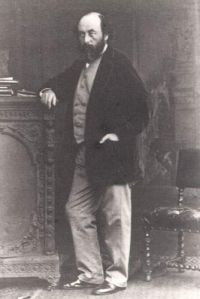
Joseph Beete Jukes

Joseph Beete Jukes

Summary

Portrait of Joseph Beete Jukes Joseph Beete Jukes The South Staffordshire Coalfield… (1859)

When the boundary of a coal field has been formed by simple denudation, without any faults in the neighbourhood, we can follow the beds of coal under the other rock without much regarding it; it is simply an additional matter of so much thickness interposed between the surface and the bed, and if the dip of of the two rocks be known, and the surface be levelled, the depth of the coal can be calculated with the greatest facility. When, however, the boundary of a coal-field is caused by a fault, the mere dip of the rocks is no longer a trustworthy guide to us.
Source: Wikisource

Portrait of Joseph Beete Jukes Joseph Beete Jukes The South Staffordshire Coalfield… (1859)

The determination of the nature and character of the boundary faults of the coal-fields, therefore, is one of the most important practical points which it is the province and the duty of a Geological survey to solve, since it is one of those least within the power of on individual observer, examining only small and isolated localities, to understand and explain.
Source: Wikisource

Portrait of Joseph Beete Jukes Joseph Beete Jukes The South Staffordshire Coalfield… (1859)

If we start from the natural boundary of the red marl, south of Bromsgrove, and walk across the country to the pebble beds of the Lickey Hill, a distance of about four miles, we should find that every exposed piece of rock showed a dip to the southward or south-westward, sometimes at an angle even of 10°. Whatever allowance we make, therefore, for undulations of the beds, we must necessarily suppose a very considerable thickness to interpose between the bottom of the red marls and the bottom of the pebble beds.
Source: Wikisource

Get perspective with Kwize: daily news enlightened by great literature