Summary

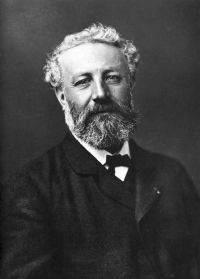
Portrait of Jules Verne Jules Verne,  Around the Moon — Chapter XVII (1873)

“ The projectile was still advancing, and this movement did not subside. Circles, craters, and uprooted mountains succeeded each other incessantly. No more plains; no more seas. A never ending Switzerland and Norway. And lastly, in the canter of this region of crevasses, the most splendid mountain on the lunar disc, the dazzling Tycho, in which posterity will ever preserve the name of the illustrious Danish astronomer.
In observing the full moon in a cloudless sky no one has failed to remark this brilliant point of the southern hemisphere.
”
Source: Wikisource

Portrait of Jules Verne Jules Verne,  Around the Moon — Chapter XVII (1873)

“ This moon is nothing more than a thin carcase of fireworks, whose squibs, rockets, serpents, and suns, after a superb brilliancy, have left but sadly broken cases. Who can say the cause, the reason, the motive force of these cataclysms?"
Barbicane was not listening to Michel Ardan; he was contemplating these ramparts of Clavius, formed by large mountains spread over several miles. At the bottom of the immense cavity burrowed hundreds of small extinguished craters, riddling the soil like a colander, and overlooked by a peak 15,000 feet high.
”
Source: Wikisource

Portrait of Jules Verne Jules Verne,  Around the Moon — Chapter XVII (1873)

“ At six in the evening the projectile passed the south pole at less than forty miles off, a distance equal to that already reached at the north pole. The elliptical curve was being rigidly carried out.
At this moment the travelers once more entered the blessed rays of the sun. They saw once more those stars which move slowly from east to west. The radiant orb was saluted by a triple hurrah. With its light it also sent heat, which soon pierced the metal walls. The glass resumed its accustomed appearance. The layers of ice melted as if by enchantment
”
Source: Wikisource

Get perspective with Kwize: daily news enlightened by great literature