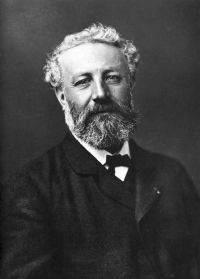
Jules Verne

Jules Verne

Summary

Portrait of Jules Verne Jules Verne Around the World in 80 Days (1873)

Passepartout could hold in no longer.
"My master! Mr. Fogg!" he cried, "why do you not curse me? It was my fault that—"
"I blame no one," returned Phileas Fogg, with perfect calmness. "Go!"
Passepartout left the room, and went to find Aouda, to whom he delivered his master's message.
"Madam," he added, "I can do nothing myself—nothing! I have no influence over my master; but you, perhaps—"
"What influence could I have?" replied Aouda. "Mr. Fogg is influenced by no one. Has he ever understood that my gratitude to him is overflowing? Has he ever read my heart?
Source: Gutenberg

Portrait of Jules Verne Jules Verne Around the World in 80 Days (1873)

At this moment Sir Francis and the guide seized Phileas Fogg, who, in an instant of mad generosity, was about to rush upon the pyre. But he had quickly pushed them aside, when the whole scene suddenly changed. A cry of terror arose. The whole multitude prostrated themselves, terror-stricken, on the ground.
The old rajah was not dead, then, since he rose of a sudden, like a spectre, took up his wife in his arms, and descended from the pyre in the midst of the clouds of smoke, which only heightened his ghostly appearance.
Source: Gutenberg

Portrait of Jules Verne Jules Verne Around the World in 80 Days (1873)

Fogg was asleep to tell Fix and Passepartout whom she had seen.
"That Proctor on this train!" cried Fix. "Well, reassure yourself, madam; before he settles with Mr. Fogg; he has got to deal with me! It seems to me that I was the more insulted of the two."
"And, besides," added Passepartout, "I'll take charge of him, colonel as he is."
"Mr. Fix," resumed Aouda, "Mr. Fogg will allow no one to avenge him. He said that he would come back to America to find this man. Should he perceive Colonel Proctor, we could not prevent a collision which might have terrible results. He must not see him."
Source: Gutenberg

Get perspective with Kwize: daily news enlightened by great literature