Summary

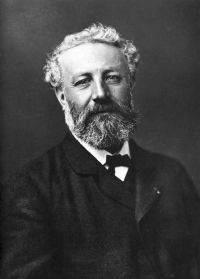
Portrait of Jules Verne Jules Verne Hector Servadac (Frewer translation… (1906)

Whence came it that a new blazing spheroid, hitherto unknown to astronomy, now appeared suddenly in the firmament, though it were but to lose itself immediately behind masses of accumulated cloud?
What phenomenon was this that had produced a cataclysm so tremendous in its effects upon earth, sky, and sea?
Was it possible that a single human being could have survived the convulsion?
Source: Wikisource

Portrait of Jules Verne Jules Verne Hector Servadac (Frewer translation… (1906)

Important changes have resulted from the collision; the cardinal points have been displaced; gravity has been diminished: not that I ever supposed for a minute, as you did, that I was still upon the earth. No! the earth, attended by her moon, continued to rotate along her proper orbit. But we, gentlemen, have nothing to complain of; our destiny might have been far worse; we might all have been crushed to death, or the comet might have remained in adhesion to the earth
Source: Wikisource

Portrait of Jules Verne Jules Verne Hector Servadac (Frewer translation… (1906)

The nucleus of the comet, being excessively hard, has done exactly what a ball would do fired with that velocity close to a pane of glass. It has crossed the earth without cracking it.”
“It is possible you may be right,” said Servadac, thoughtfully.
“Right! of course I am right!” replied the snappish professor. Soon, however, recovering his equanimity, he continued: “It is fortunate that the earth was only touched obliquely; if the comet had impinged perpendicularly, it must have ploughed its way deep below the surface, and the disasters it might have caused are beyond reckoning.
Source: Wikisource

Get perspective with Kwize: daily news enlightened by great literature