Summary

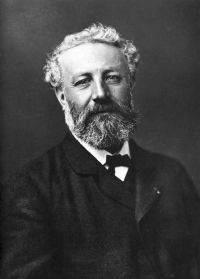
Portrait of Jules Verne Jules Verne Hector Servadac (Frewer translation… (1906)

Tropez, the Lérius Islands, and the gulfs of Cannes and Jouar, the Dobryna arrived upon the site of the Cape of Antibes.
Here, quite unexpectedly, the explorers made the discovery that the massive wall of cliff had been rent from the top to the bottom by a narrow rift, like the dry bed of a mountain torrent, and at the base of the opening, level with the sea, was a little strand upon which there was just space enough for their boat to be hauled up.
“Joy! joy!” shouted Servadac, half beside himself with ecstasy; “we can land at last!”
Source: Wikisource

Portrait of Jules Verne Jules Verne Hector Servadac (Frewer translation… (1906)

Not yet have we reached the pole of our new world. There is—there must be—something more behind that frowning rock. Oh, that for a moment we could scale its towering height and look beyond! By Heaven, I adjure you, let us disembark, and mount the summit and explore! France lies beyond.”
Disembarkation, however, was an utter impossibility There was no semblance of a creek in which the Dobryna could find an anchorage.
Source: Wikisource

Portrait of Jules Verne Jules Verne Hector Servadac (Frewer translation… (1906)

It might have been supposed that Servadac's previous experiences would have prepared him for the discovery that the catastrophe which had overwhelmed other sites had brought destruction to his own country as well But he had failed to realize how it might extend to France; and when now he was obliged with his own eyes to witness the waves of ocean rolling over what once had been the lovely shores of Provence, he was well-nigh frantic with desperation.
“Am I to believe that Gourbi Island, that little shred of Algeria, constitutes all that is left of our glorious France? No, no; it cannot be.
Source: Wikisource

Get perspective with Kwize: daily news enlightened by great literature