Summary

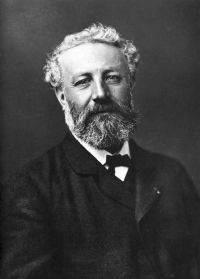
Portrait of Jules Verne Jules Verne Hector Servadac (Frewer translation… (1906)

A FROZEN OCEAN. The moon! She had disappeared for weeks; was she now returning? Had she been faithless to the earth? and had she now approached to be a satellite of the new-born world?
“Impossible!” said Lieutenant Procope; “the earth is millions and millions of leagues away, and it is not probable that the moon has ceased to revolve about her.”
“Why not?” remonstrated Servadac. “It would not be more strange than the other phenomena which we have lately witnessed. Why should not the moon have fallen within the limits of Gallia's attraction, and become her satellite?”
Source: Wikisource

Portrait of Jules Verne Jules Verne Hector Servadac (Frewer translation… (1906)

To mistake its identity with the moon was absolutely impossible; not even Servadac could discover a trace of the seas, chasms, craters, and mountains which have been so minutely delineated in lunar charts; and it could not be denied that any transient hope that had been excited as to their once again being about to enjoy the peaceful smiles of “the queen of night” must all be resigned.
Count Timascheff finally suggested, though somewhat doubtfully, the question of the probability that Gallia, in her course across the zone of the minor planets, had carried off one of them
Source: Wikisource

Portrait of Jules Verne Jules Verne Hector Servadac (Frewer translation… (1906)

Extreme violence in physical, as well as in moral nature, is never of long duration. The most terrible storms, like the most violent fits of passion, are not lasting; but here the calm flow of the liquid fire appeared to be supplied from a source that was inexhaustible, in the same way as the waters of Niagara, gliding on steadily to their final plunge, would defy all effort to arrest their course.
Source: Wikisource

Get perspective with Kwize: daily news enlightened by great literature