Summary

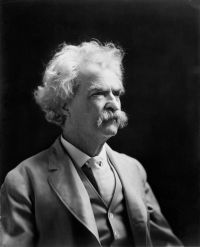
Portrait of Mark Twain Mark Twain Life on the Mississippi — Chapter 16 (1883)

In the old times, whenever two fast boats started out on a race, with a big crowd of people looking on, it was inspiring to hear the crews sing, especially if the time were night-fall, and the forecastle lit up with the red glare of the torch-baskets. Racing was royal fun. The public always had an idea that racing was dangerous; whereas the opposite was the case--that is, after the laws were passed which restricted each boat to just so many pounds of steam to the square inch. No engineer was ever sleepy or careless when his heart was in a race.
Source: Wikisource

Portrait of Mark Twain Mark Twain Life on the Mississippi — Chapter 16 (1883)

Two nicely matched steamers will stay in sight of each other day after day. They might even stay side by side, but for the fact that pilots are not all alike, and the smartest pilots will win the race. If one of the boats has a 'lightning' pilot, whose 'partner' is a trifle his inferior, you can tell which one is on watch by noting whether that boat has gained ground or lost some during each four-hour stretch. The shrewdest pilot can delay a boat if he has not a fine genius for steering. Steering is a very high art.
Source: Wikisource

Portrait of Mark Twain Mark Twain Life on the Mississippi — Chapter 16 (1883)

One must not keep a rudder dragging across a boat's stem if he wants to get up the river fast.
There is a great difference in boats, of course. For a long time I was on a boat that was so slow we used to forget what year it was we left port in. But of course this was at rare intervals. Ferryboats used to lose valuable trips because their passengers grew old and died, waiting for us to get by.
Source: Wikisource

Get perspective with Kwize: daily news enlightened by great literature