Summary

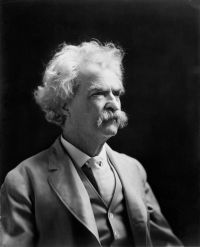
Portrait of Mark Twain Mark Twain Life on the Mississippi, Part 4

Steamer after steamer falls into line, and the stately procession goes winging its flight up the river.
In the old times, whenever two fast boats started out on a race, with a big crowd of people looking on, it was inspiring to hear the crews sing, especially if the time were night-fall, and the forecastle lit up with the red glare of the torch-baskets. Racing was royal fun. The public always had an idea that racing was dangerous; whereas the opposite was the case—that is, after the laws were passed which restricted each boat to just so many pounds of steam to the square inch.
Source: Gutenberg

Portrait of Mark Twain Mark Twain Life on the Mississippi, Part 4

When the river is rising fast, some scoundrel whose plantation is back in the country, and therefore of inferior value, has only to watch his chance, cut a little gutter across the narrow neck of land some dark night, and turn the water into it, and in a wonderfully short time a miracle has happened: to wit, the whole Mississippi has taken possession of that little ditch, and placed the countryman's plantation on its bank (quadrupling its value) , and that other party's formerly valuable plantation finds itself away out yonder on a big island
Source: Gutenberg

Portrait of Mark Twain Mark Twain Life on the Mississippi, Part 4

And by the same token any person can see that seven hundred and forty-two years from now the Lower Mississippi will be only a mile and three-quarters long, and Cairo and New Orleans will have joined their streets together, and be plodding comfortably along under a single mayor and a mutual board of aldermen. There is something fascinating about science. One gets such wholesale returns of conjecture out of such a trifling investment of fact.
Source: Gutenberg

Get perspective with Kwize: daily news enlightened by great literature