Summary

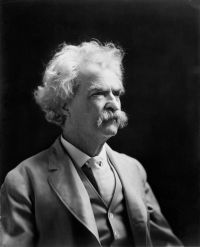
Portrait of Mark Twain Mark Twain Life on the Mississippi, Part 3

If you will take the longest street in New York, and travel up and down it, conning its features patiently until you know every house and window and door and lamp-post and big and little sign by heart, and know them so accurately that you can instantly name the one you are abreast of when you are set down at random in that street in the middle of an inky black night, you will then have a tolerable notion of the amount and the exactness of a pilot's knowledge who carries the Mississippi River in his head.
Source: Gutenberg

Portrait of Mark Twain Mark Twain Life on the Mississippi, Part 3

Fill that whole region with an impenetrable gloom of smoke from a hundred miles of burning bagasse piles, when the river is over the banks, and turn a steamboat loose along there at midnight and see how she will feel. And see how you will feel, too! You find yourself away out in the midst of a vague dim sea that is shoreless, that fades out and loses itself in the murky distances; for you cannot discern the thin rib of embankment, and you are always imagining you see a straggling tree when you don't. The plantations themselves are transformed by the smoke, and look like a part of the sea.
Source: Gutenberg

Portrait of Mark Twain Mark Twain Life on the Mississippi, Part 3

I think a pilot's memory is about the most wonderful thing in the world. To know the Old and New Testaments by heart, and be able to recite them glibly, forward or backward, or begin at random anywhere in the book and recite both ways and never trip or make a mistake, is no extravagant mass of knowledge, and no marvelous facility, compared to a pilot's massed knowledge of the Mississippi and his marvelous facility in the handling of it.
Source: Gutenberg

Get perspective with Kwize: daily news enlightened by great literature