Summary

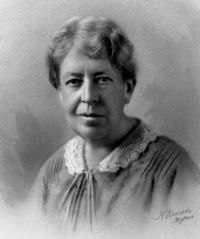
Portrait of Mary Whiton Calkins Mary Whiton Calkins The Metaphysical Monist as a Sociological Pluralist (1920)

Now all the arguments known to me for the self-conception of society fall far short of establishing the truth that a social group is in this sense a person. Such arguments seem to fall into two groups:
1. There is first the consideration, eloquently urged by Royce, that a man may love his country—church or country—and be loyal to it and sacrifice himself for it as if it were a self. In other words, Royce argues (and in my opinion very effectively) that a society is regarded by its members as a self. But this certainly does not prove that a society is a self.
Source: Wikisource

Portrait of Mary Whiton Calkins Mary Whiton Calkins The Metaphysical Monist as a Sociological Pluralist (1920)

There is, to be sure, a sense in which the conception of the social group as a self may be said to be facilitated by the Absolute-Self-doctrine. For if the universe is rightly conceived as One Self, including all the unnumbered lesser selves of the universe, there is apparent reason for describing races, societies, communities each as a sort of intermediate self of many interrelated persons.
Source: Wikisource

Portrait of Mary Whiton Calkins Mary Whiton Calkins The Metaphysical Monist as a Sociological Pluralist (1920)

Community, association, and state, so far as they are personified, are therefore sociological and neither psychological nor metaphysical units, constructs of the socially minded selves who compose them. Hach of these members of society is distinctively conscious of himself as in close mutual relation with his fellows and each may personify the social group and conceive it, feel toward it, or behave toward it as if it were a person. But the social group, even when personified, remains a plurality, larger or smaller, of the selves who are ultimately related as members of the Absolute Self.
Source: Wikisource

Get perspective with Kwize: daily news enlightened by great literature