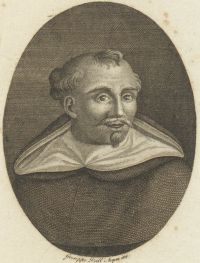
Matteo Bandello

Matteo Bandello

Summary

Portrait of Matteo Bandello Matteo Bandello Matteo Bandello: Twelve Stories (1895)

After countless kisses and endearments, Galeazzo, still weeping, asked Lucrezia, "Say, sweetheart, how did you do without me? What sort of life was yours? Did it not grieve you sore never to see me all this while? In truth, I thought I should die, nor can I rightly tell why still I live. Ah! life of my life, who shall assure me that others, in this time of your absence from me, have not enjoyed your beauty? Jealousy is like to kill me, and my very heart is broken within my body.
Source: Wikisource

Portrait of Matteo Bandello Matteo Bandello Matteo Bandello: Twelve Stories (1895)

It is remarkable that, while all, or nearly all, his tales contain the germs of drama, being tragedies and comedies in brief, Bandello should himself have no dramatic sense. With something of the frank unconsciousness of a child he handles his vast materials dexterously, almost jocularly, yet with no clear perception of their deep tragic and spiritual significance. The tale for him is just a tale, to move, to divert one for the moment
Source: Wikisource

Portrait of Matteo Bandello Matteo Bandello Matteo Bandello: Twelve Stories (1895)

In conclusion, we must admit that Bandello's work is valuable to us as a specimen of the literature which found wide favour with all classes in Italy at the time of the Renascence. It reflects the whole of Italian society, and gives us surprisingly truthful, vivid pictures of its manners and its life. Nor by any one of his contemporaries has the sheer craft of story-telling been more convincingly shown than by the worldly, pleasure-loving, genial bishop to whom Leandro Alberti refers as virum in scribendo, floridum, clarum, nitidum, emunctum et accuratum.
Source: Wikisource

Get perspective with Kwize: daily news enlightened by great literature