“ Perhaps his story had taken him back to happy days and to Venice. He caught up his clarionet and made plaintive music, playing a Venetian boat-song with something of his lost skill, the skill of the young patrician lover. It was a sort of Super flumina Babylonis. Tears filled my eyes. Any belated persons walking along the Boulevard Bourdon must have stood still to listen to an exile's last prayer, a last cry of regret for a lost name, mingled with memories of Bianca. But gold soon gained the upper hand, the fatal passion quenched the light of youth. ”
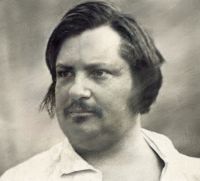
Honoré de Balzac
Summary
“Facino Cane”, is a work by Honoré de Balzac. It explores elements such as Facino Cane, clarionet and Venice.
Quotes from Facino Cane (Honoré de Balzac)
“ I thought of nothing else; the wedding party and the music ceased to exist, my curiosity was roused to the highest pitch, for my soul passed into the body of the clarionet player. The fiddle and the flageolet were neither of them interesting; their faces were of the ordinary type among the blind—earnest, attentive, and grave. Not so the clarionet player; any artist or philosopher must have come to a stop at the sight of him. ”
“ One passion only had power to draw me from my studies; and yet, what was that passion but a study of another kind? I used to watch the manners and customs of the Faubourg, its inhabitants, and their characteristics. As I dressed no better than a working man, and cared nothing for appearances, I did not put them on their guard; I could join a group and look on while they drove bargains or wrangled among themselves on their way home from work. Even then observation had come to be an instinct with me; a faculty of penetrating to the soul without neglecting the body ”
