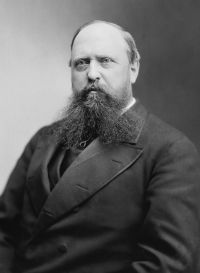
Othniel Charles Marsh

Othniel Charles Marsh

Summary

Portrait of Othniel Charles Marsh Othniel Charles Marsh The American Journal of Science (1896)

It is only justice to Dr. Dubois and his admirable memoir to say here, that he has proved to science the existence of a new prehistoric anthropoid form, not human indeed, but in size, brain power, and erect posture, much nearer man than any animal hitherto discovered, living or extinct. . . . . . Whatever light future researches may throw upon the affinities of this new form that left its remains in the volcanic deposits of Java during later Tertiary time, there can be no doubt that the discovery itself is an event equal in interest to that of the Neanderthal skull.
Source: Wikisource

Portrait of Othniel Charles Marsh Othniel Charles Marsh The American Journal of Science (1896)

The man of the Neander valley remained without honor, even in his own country, for more than a quarter of a century, and was still doubted and reviled when his kinsmen, the men of Spy, came to his defense, and a new chapter was added to the early history of the human race. The ape-man of Java comes to light at a more fortunate time, when zeal for exploration is so great that the discovery of additional remains may be expected at no distant day.
Source: Wikisource

Portrait of Othniel Charles Marsh Othniel Charles Marsh The American Journal of Science (1895)

This memoir of forty pages contains a full description, with illustrations, of part of a skull, a molar tooth, and a femur, found in the later Tertiary strata of Java, and pertaining to a large anthropoid ape, which is believed to represent a new genus and family intermediate between the Simiidæ and Hominidæ. This would make it a veritable "missing link" between the higher apes and man, the discovery of which has so long been confidently predicted by many anthropologists.
Source: Wikisource

Get perspective with Kwize: daily news enlightened by great literature