Summary

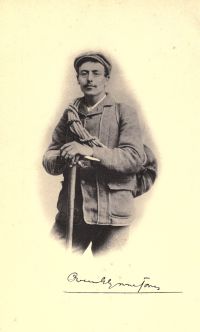
Portrait of Owen Glynne Jones Owen Glynne Jones Rock-climbing in the English Lake District

Walking eastwards along the scree beneath the crags, it is the first really obvious passage into the heart of the mountain after leaving the Doctor’s Chimney; the easy scree walk is not much impressed in the face, and in a mist it has often been entirely overlooked. Even in cloudy weather the first pitch of our gully can be discerned a few feet above us, and identified by the buttress that partially divides it, the chock-stone in its right branch, and the fine-looking ‘jammed-stone pinnacle’ that shows up a little higher on the left.
Source: Gutenberg

Portrait of Owen Glynne Jones Owen Glynne Jones Rock-climbing in the English Lake District

Some in their wrath have desired to get the photographer and his camera below them in a rickety gully, where, as Dent puts it, no stone is left unturned in their struggle to reach the top.
But if the artist cuts away a few thousand tons of rock from his negative with one fell stroke of his brush, if he commands the sun to stand still and the shadows to move on, if he subjects his angles to the influence of the personal equation of the climber instead of the mere observer, these weaknesses are not to be recorded against him.
Source: Gutenberg

Portrait of Owen Glynne Jones Owen Glynne Jones Rock-climbing in the English Lake District

Dependence is often placed on small footholds that slope slightly to the climber’s disadvantage; and on such ledges good nailed boots and perfect confidence are essential. The fact is that the ridge is not to be recommended; and its virtue is that there is no deception about it. The clean sweep of the sharp nose of rock from the green platform at the foot up to the patch of grass where the slanting chimney begins scares everybody away, tyros and experts alike. That almost vertical buttress looks impossible, and to nearly everybody it is so.
Source: Gutenberg

Get perspective with Kwize: daily news enlightened by great literature