Summary

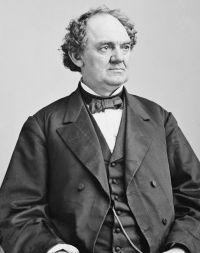
Portrait of P. T. Barnum P. T. Barnum The Humbugs of the World — Chapter L (1866)

However that may be, he was subsequently worshiped with divine honors, and so highly esteemed by the greatest men of after days, that even Aurelian refused to sack Tyana, out of respect to the philosopher’s ashes.
Dion Cassius, the historian, records one of the most remarkable instances of his clairvoyance or second sight. He states that Apollonius, in the midst of a discourse at Ephesus, suddenly paused, and then in a different voice, exclaimed, to the astonishment of all:—“Have courage, good Stephanus! Strike! strike! Kill the tyrant!”
Source: Wikisource

Portrait of P. T. Barnum P. T. Barnum The Humbugs of the World — Chapter L (1866)

The next morning, the philosopher commanded the throng to remove the pile of stones, and as they did so, a dog was discovered instead of the beggar. The dog sprang up, wagged his tail, and made away at “two-forty” and with him the pestilence departed. For this feat, the Ephesians called Apollonius a god, and reared a statue to his honor. The appellation of divinity he willingly accepted, declaring that it was only justice to good men. In these degenerate days, we have accorded the term to only one person, “the divine Fanny Elssler!”
Source: Wikisource

Portrait of P. T. Barnum P. T. Barnum The Humbugs of the World — Chapter L (1866)

We have men in our own country who can talk “horse-talk” at the races, but probably none so perfectly as this great Tyanean. The author of “The Ruined Cities of Africa,” a recent publication, informs us that at Lamba, an African village, there is a leopard who can “speak.” This would go to show that the “animals,” are aspiring in a direction directly the opposite of the acquirements of Apollonius, and I shall secure that leopard, if possible, for exhibition in the Museum, and for a fair consideration send him to any public meeting where some one is needed who will come up to the scratch!
Source: Wikisource

Get perspective with Kwize: daily news enlightened by great literature