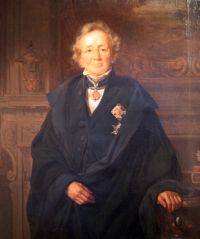
Philip Arthur Ashworth

Philip Arthur Ashworth

Summary

Portrait of Philip Arthur Ashworth Philip Arthur Ashworth 1911 Encyclopædia Britannica (1911)

In Jhering the philosophical conception of jurisprudence, as a science to be utilized for the further advancement of the moral and social interests of mankind, was predominant. In 1868 Jhering accepted the chair of Roman Law at Vienna, where his lecture-room was crowded, not only with regular students but with men of all professions and even of the highest ranks in the official world.
Source: Wikisource

Portrait of Philip Arthur Ashworth Philip Arthur Ashworth 1911 Encyclopædia Britannica (1911)

He became one of the lions of society, the Austrian emperor conferring upon him in 1872 a title of hereditary nobility. But to a mind constituted like his, the social functions of the Austrian metropolis became wearisome, and he gladly exchanged its brilliant circles for the repose of Göttingen, where he became professor in 1872. In this year he had read at Vienna before an admiring audience a lecture, published under the title of Der Kampf um’s Recht (1872; Eng. trans., Battle for Right, 1884) .
Source: Wikisource

Portrait of Philip Arthur Ashworth Philip Arthur Ashworth 1911 Encyclopædia Britannica (1911)

The farms in Alsace are mostly small and are held partly as a private possession, partly on the communal system; in Lorraine there are some larger occupations. The manufacture of cottons, and on a smaller scale of woollens, is special to Alsace, the chief centres of the industry being Mülhausen, Colmar and the valleys of the Vosges. The territory has always been the centre of an active commerce, owing to its situation on the confines of Germany, France and Switzerland, and alongside the great highway of the Rhine.
Source: Wikisource

Get perspective with Kwize: daily news enlightened by great literature