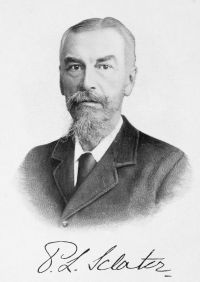
Philip Lutley Sclater

Philip Lutley Sclater

Summary

Portrait of Philip Lutley Sclater Philip Lutley Sclater The book of antelopes, vol. 3… (1897)

As the traveller advances over the trackless expanse, hundreds of this delicately formed antelope bound away on either side of his path with meteor-like and sportive velocity, winging their bird-like flight by a quick succession of those singularly elastic leaps which have given rise to its colonial appellation, and which enable it to surpass, as well in swiftness as in grace, almost every other mammiferous quadruped.
Source: Gutenberg

Portrait of Philip Lutley Sclater Philip Lutley Sclater The book of antelopes, vol. 3… (1897)

It is a grass-feeder, and lives in the open plains or in scattered bush, and never in thick jungle, and prefers tolerably flat ground. The white hind-quarters can be seen from a great distance, making a herd of Aoul look like a flock of sheep in the haze of the plains. I have never seen them in the cedar-forests on the top of Gólis, but in the hartebeest-ground to the south they are common. They are often met with in large herds along with the hartebeests, and are very common all over the Haud and Ogádén and near the Webbe.
Source: Gutenberg

Portrait of Philip Lutley Sclater Philip Lutley Sclater The book of antelopes, vol. 3… (1897)

The master buck of the herd, seeing an impertinent intruder on his ground, trots out at once to do battle for the doe, but the screen puzzles him, so before coming close he generally circles round to try and see behind it. As he moves, the screen is shifted round, the men scrambling round on hands and knees behind it, and if there are two Englishmen bursting with suppressed laughter in addition to the two natives, all scuffling round as the screen moves and trying to keep their legs out of sight, the business is most comical.
Source: Gutenberg

Get perspective with Kwize: daily news enlightened by great literature