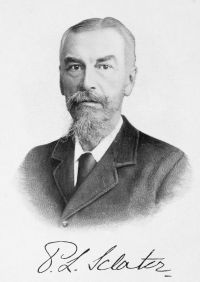
Philip Lutley Sclater

Philip Lutley Sclater

Summary

Portrait of Philip Lutley Sclater Philip Lutley Sclater The book of antelopes, vol. 4… (1899)

The appearance of a herd of Oryx is very imposing. They are some of the most elegant and symmetrical of animals, their motions being those of a wild horse rather than of an Antelope. Their favourite pace appears to be either a steady quick walk or a trot; they rarely break into a gallop unless greatly alarmed. When frightened, they dash off, sometimes snorting and putting their heads down as if charging, raising their long tails, and looking very formidable.
Source: Gutenberg

Portrait of Philip Lutley Sclater Philip Lutley Sclater The book of antelopes, vol. 4… (1899)

The natives of Southern Africa occasionally arm their spears with the horns of the Oryx; and the Hollanders of the Cape have them polished and headed with silver, to serve as walking-sticks, for which purpose they are frequently too long! Strong, active, and vigorous, the Gemsbok boldly defends itself when pressed by the hunter, using its horns with amazing energy and address, by striking right and left at its assailant with prodigious violence.
Source: Gutenberg

Portrait of Philip Lutley Sclater Philip Lutley Sclater The book of antelopes, vol. 4… (1899)

In 1879 I tried hard to shoot some of these animals on the Chobe, searching for them in a canoe amongst the reed-beds at early dawn and after sunset; but though I disturbed several, and heard them splashing away amongst the reeds and papyrus, I only saw one female alive, though one morning I found a fine ram lying dead that had evidently been killed fighting with a rival during the night. The head and feet of this animal I preserved. The female that I saw was standing breast deep in the water, in the midst of a bed of reeds, feeding on the young shoots that just appeared above the water.
Source: Gutenberg

Get perspective with Kwize: daily news enlightened by great literature