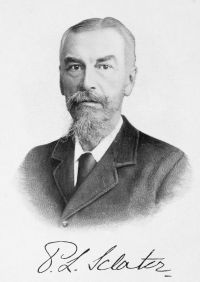
Philip Lutley Sclater

Philip Lutley Sclater

Summary

Portrait of Philip Lutley Sclater Philip Lutley Sclater The book of antelopes, vol. 2… (1897)

The chest, belly, and orbits are nearly white, the front of the legs and ankles deep brown. From the horns, along the nape to the withers, the male has a small mane of the same yellowish colour with the rest of the skin, and the tail has a tuft of black hair. It is never found a mile from water; islets in marshes and rivers are its favourite haunts, and it is quite unknown except in the central humid basin of Africa. Having a good deal of curiosity, it presents a noble appearance as it stands gazing with head erect at the approaching stranger.
Source: Gutenberg

Portrait of Philip Lutley Sclater Philip Lutley Sclater The book of antelopes, vol. 2… (1897)

Constantly the dainty little Sand-antelopes would spring away through the bushes at my approach. These charming little creatures, called in Somali-land ‘Dĭk-dĭks,’ in size scarcely as big as an English hare, are the most dainty miniatures of the Antelope race. They are ever in pairs of male and female, are much alike, except that the male has two tiny horns about an inch or two long, with a brown tuft of hair between them. Their skins vary in colour from a silvery grey to a russet-brown.
Source: Gutenberg

Portrait of Philip Lutley Sclater Philip Lutley Sclater The book of antelopes, vol. 2… (1897)

In 1840 Sir Cornwallis Harris figured this species—not, we must allow, very accurately—in his great work on the ‘Game and Wild Animals of South Africa.’ Although not found within the limits of Cape-land proper, the Waterbuck, Harris tells us, abounded in his days on the margins of the willow-grown Limpopo and its tributaries, in the “rippling waters of which it delights to lave its grizzled sides, immersing itself up to the chin during the heat of the day and rolling in its favourite soiling-pool for hours together.”
Source: Gutenberg

Get perspective with Kwize: daily news enlightened by great literature