Summary

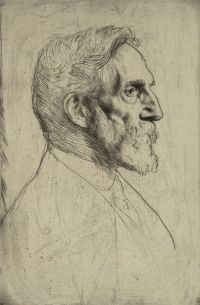
Portrait of Philip Norman Philip Norman Drawings of Old London

Great, rambling, queer old places they are, with galleries, and passages, and staircases, wide enough and antiquated enough to furnish material for a hundred ghost stories. It was in the yard of one of these inns—of no less celebrated a one than the White Hart—that a man was busily employed in brushing the dirt off a pair of boots, early on the morning succeeding the events narrated in the last chapter. The yard presented none of that bustle and activity which are the usual characteristics of a large coach inn.
Source: Gutenberg

Portrait of Philip Norman Philip Norman Drawings of Old London

And here, on the east side of Davies Street, named after her, stands Bourdon House, a pleasant old dwelling, over-shadowed by the trees 36 which grow in its little courtyard. Inside, the most noteworthy feature is the carved woodwork, which seems to be French in style, dating, perhaps, from the early part of the eighteenth century. There is a strong tradition that this house was originally occupied by the Davies family; it is certainly one of the oldest on the estate. The name Bourdon first appears on the parish rate books in 1739. Within the last few years the house has been enlarged.
Source: Gutenberg

Portrait of Philip Norman Philip Norman Drawings of Old London

Architecturally the Bell was interesting, because, with one possible exception, it was the last galleried inn in London on the Middlesex side of the river, though until the advent of railways such houses were common. The galleries were perhaps as old as the reign of Charles II. A still older portion was a cellar immediately to the left of the entrance, which was built of stone with well laid masonry and might have been mediæval. All the rest of the buildings seem to have dated from the earlier part of the eighteenth century.
Source: Gutenberg

Get perspective with Kwize: daily news enlightened by great literature