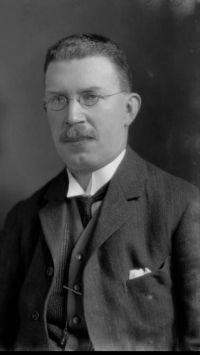
Reynold Alleyne Nicholson

Reynold Alleyne Nicholson

Summary

Portrait of Reynold Alleyne Nicholson Reynold Alleyne Nicholson The Mystics of Islam (1914)

Let us return for a moment to the Koran, that infallible touchstone by which every Mohammedan theory and practice must be proved. Are any germs of mysticism to be found there? The Koran, as I have said, starts with the notion of Allah, the One, Eternal, and Almighty God, far above human feelings and aspirations—the Lord of His slaves, not the Father of His children; a judge meting out stern justice to sinners, and extending His mercy only to those who avert His wrath by repentance, humility, and unceasing works of devotion; a God of fear rather than of love.
Source: Gutenberg

Portrait of Reynold Alleyne Nicholson Reynold Alleyne Nicholson The Mystics of Islam (1914)

This knowledge comes by illumination, revelation, inspiration.
“Look in your own heart,” says the Sūfī, “for the kingdom of God is within you.” He who truly knows himself knows God, for the heart is a mirror in which every divine quality is reflected. But just as a steel mirror when coated with rust loses its power of reflexion, so the inward spiritual sense, which Sūfīs call the eye of the heart, is blind to the celestial glory until the dark obstruction of the phenomenal self, with all its sensual contaminations, has been wholly cleared away.
Source: Gutenberg

Portrait of Reynold Alleyne Nicholson Reynold Alleyne Nicholson The Mystics of Islam (1914)

For every one of the veils of light passed through, in this journey towards birth, the soul puts off a divine quality: and for every one of the dark veils, it puts on an earthly quality. Thus the child is born weeping, for the soul knows its separation from Allah, the One Reality. And when the child cries in its sleep, it is because the soul remembers something of what it has lost.
Source: Gutenberg

Get perspective with Kwize: daily news enlightened by great literature