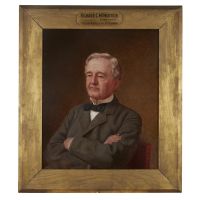
Richard Coxe McMurtrie

Richard Coxe McMurtrie

Summary

Portrait of Richard Coxe McMurtrie Richard Coxe McMurtrie Chandelor v. Lopus (1887)

Put the case in legal form in either of the two possible aspects it could assume to create a liability, and all these things become material. Was there deceit ? — i.e., successful fraud and damage resulting, — or was there a contract, in which case fraud or knowledge or deception become immaterial?
My object is to redeem the famous case from being relegated to the rubbish of the past, and show it up as a specimen of as perfect law as can be produced at this day; and which, as a point of law, must last as long as a claim or a defence must be stated. For it really decides two things.
Source: Wikisource

Portrait of Richard Coxe McMurtrie Richard Coxe McMurtrie Chandelor v. Lopus (1887)

There is no reason to suspect intentional deceit in either case. That a statement is untrue goes but a little way to prove lying. For one fact we know there are a million we assume we know, and yet know nothing in that sense that makes an untrue statement a lie. The merchant that shows a sample relies on a drawer of the sample, and he on a deputy, and he on the laborer that brings out the lot from which it is to be drawn.
The liability to make the statement good, if it is not true, is sufficient, for all practical purposes, to insure efforts to make it true.
Source: Wikisource

Portrait of Richard Coxe McMurtrie Richard Coxe McMurtrie Chandelor v. Lopus (1887)

One is a rule of pleading, which in modern times is thus stated, — that things must be stated according to their legal effect. Evidence cannot be stated either in declaration or plea, because the issue would be confined to the existence of that evidence, and its effect would be an immaterial matter. The other point decided is that a mere statement, unless it was made as a contract or was made fraudulently, is immaterial, and if either of these is relied on they must be pleaded accordingly.
Source: Wikisource

Get perspective with Kwize: daily news enlightened by great literature