Summary

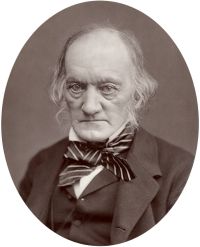
Portrait of Richard Owen Richard Owen Antiquity of Man as Deduced from the Discovery of a Human Skeleton (1884)

But, whatever its physical composition, we may regard the stratum as being that on which the man moved who therein left his bones. As man he must have breathed an aerial atmosphere—in other words, have trod the then surface of the earth. To receive the overlying bed the supporting one subsided; the level of the ground there to that extent has consequently changed. Both strata are now very far down.
Here we may pause to consider for how long a period the surface of the banks of the Thames has remained at its present level.
Source: Wikisource

Portrait of Richard Owen Richard Owen Antiquity of Man as Deduced from the Discovery of a Human Skeleton (1884)

Should the scrutiny of experienced Students of Surface- modifications be rewarded by an indication or proof of any change in the geological characters of the north bank of the Thames since Julius Cæsar's or Vespasian's time, it must be insignificant compared with that period during which occurred a subsidence of the soil, rendering that bank uninhabitable by the man of the black-sand epoch. His progeny or kind may have survived such change, have migrated landward; there is no ground for inferring the ancient race to have been swept away by a "flood."
Source: Wikisource

Portrait of Richard Owen Richard Owen Antiquity of Man as Deduced from the Discovery of a Human Skeleton (1884)

In a recess of the, of old, inhabited cave, at a depth of 5 feet 2 inches from the upper surface of the stalagmite, and in a block of stalagmitic breccia of stony hardness, a second human skull, mutilated in the labour of detachment of the matrix, was discovered with other parts of a human skeleton [16] . At every foot of depth of the breccia of the cavern were found scattered implements of flint and bone—the latter chiefly supplied by antlers of reindeer (Cervus tarandus) .
Source: Wikisource

Get perspective with Kwize: daily news enlightened by great literature