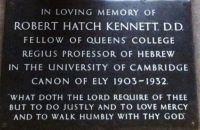
Robert Hatch Kennett

Robert Hatch Kennett

Summary

Portrait of Robert Hatch Kennett Robert Hatch Kennett 1911 Encyclopædia Britannica (1911)

The hymns which had brought comfort to the faithful in the time of their distress had become an integral part of their religion which could not be given up. Jerusalem was now the religious metropolis of a great nation, and accordingly it was felt desirable that the hymn-books of the several parts of the nation should be combined into a hymn-book for the whole. The synagogue collections, since they contained psalms which at this time were probably considered to be the work of David, were placed first, and the Temple collection added to them.
Source: Wikisource

Portrait of Robert Hatch Kennett Robert Hatch Kennett 1911 Encyclopædia Britannica (1911)

On the other hand, in a collection intended for synagogue use—and the second collection of psalms is as a whole far more suitable to a synagogue than to the Temple—where there would not be a large choir and orchestra of skilled musicians, it would obviously be desirable to state whether the psalm was to be sung to a Davidic, Asaphic or Korahite tone, or to give the name of a melody appropriate to it.
Source: Wikisource

Portrait of Robert Hatch Kennett Robert Hatch Kennett 1911 Encyclopædia Britannica (1911)

Ben Sira indeed in his list of worthies mentions Zerubbabel, Joshua and Nehemiah; but Zerubbabel and Joshua he must have known from the books of Haggai and Zechariah, and he may well have been acquainted with that document relating to Nehemiah which the Chronicler incorporated with his book. Ben Sira’s omission of the name of Ezra rather militates against the supposition that he had the Chronicler’s book before him when he wrote. The conflict between Saduceeism and the sopherim was hardly so intense in his days as to warrant the supposition that he omitted the name of Ezra intentionally.
Source: Wikisource

Get perspective with Kwize: daily news enlightened by great literature