Summary

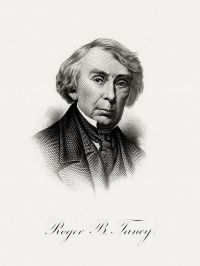
Portrait of Roger B. Taney Roger B. Taney Baldwin v. Ely — Opinion of the Court

And it would be ridiculously absurd to suppose, that, if a person cut such leaf out of a book, he, or any other person to whom he might deliver, thereby acquired a lawful right or authority to write over the name an assignment of a chose in action, or a bill of sale of a horse, or other property belonging to the person who had so written his name.
The bare writing of a name,-the bare indorsement of a name, gives no authority, transfers no property, except only in certain peculiar privileged cases, ruled and governed by the law merchant, which is not applicable to these.
Source: Wikisource

Portrait of Roger B. Taney Roger B. Taney Baldwin v. Ely — Opinion of the Court

Can he have relief until he does equity? Was not the court below bound to dismiss his bill unless he offered to redeem a mortgage thus created by his want of care?
I have avoided any discussion of much that is relied on on the other side, thinking that a general summary may suffice to correct some of the most material errors of fact and erroneous deductions which are apparent in the argument.
Mr. Ely states that he made his first advance in April, 1842, upon three certificates, the numbers of which he does not recollect, and afterwards made further advances on promises of additional security.
Source: Wikisource

Portrait of Roger B. Taney Roger B. Taney Baldwin v. Ely — Opinion of the Court

We are in equity. It is a question of evidence. The bare indorsement of negotiable paper does not transfer the title. It must be accompanied or followed by delivery. So of a chose in action, the fullest words of assignment do not transfer the title. There must be a delivery. In the former case, the negotiable paper, possession is evidence of delivery. In the latter case, the possession by the assignee is as strong prim a facie evidence.
Source: Wikisource

Get perspective with Kwize: daily news enlightened by great literature