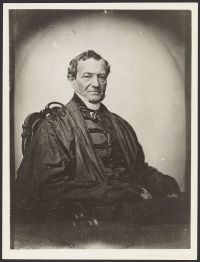
Simon Greenleaf

Simon Greenleaf

Summary

Portrait of Simon Greenleaf Simon Greenleaf Testimony of the Evangelists (1846)

Whenever an objection is raised in opposition to ordinary presumptions of law, or to the ordinary experience of mankind, the burden of proof is devolved on the objector, by the common and ordinary rules of evidence, and of practice in courts. No lawyer is permitted to argue in disparagement of the intelligence or integrity of a witness, against whom the case itself afforded no particle of testimony. This is sufficient for our purpose, in regard to these witnesses. But more than this is evident, from the minuteness of their narratives, and from their history.
Source: Wikisource

Portrait of Simon Greenleaf Simon Greenleaf Testimony of the Evangelists (1846)

To have persisted in so gross a falsehood, after it was known to them, was not only to encounter, for life, all the evils which man could inflict, from without, but to endure also the pangs of inward and conscious guilt; with no hope of future peace, no testimony of a good conscience, no expectation of honor or esteem among men, no hope of happiness in this life, or in the world to come.
Source: Wikisource

Portrait of Simon Greenleaf Simon Greenleaf Testimony of the Evangelists (1846)

It is incredible, that bad men should invent falsehoods, to promote the religion of the God of truth. The supposition is suicidal. If they did believe in a future state of retribution, a heaven and a hell hereafter, they took the most certain course, if false witnesses, to secure the latter for their portion. And if, still being bad men, they did not believe in future punishment, how came they to invent which was to destroy all their prospects of worldly honor and happiness, and to insure their misery in this life?
Source: Wikisource

Get perspective with Kwize: daily news enlightened by great literature