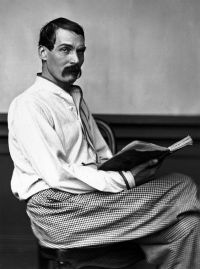
Sir Richard Francis Burton

Sir Richard Francis Burton

Summary

Portrait of Sir Richard Francis Burton Sir Richard Francis Burton Ultima Thule; or, A Summer in Iceland…

No English man-of-war deigned to grace the millenary festival of 1874—the successful effacement of Great Britain should be a matter of heartfelt congratulation to us; but gare the recoil of the spring. The evening was pleasant, as usual on board a ship of war, and the belongings wore a home look, a civilised aspect, which made it more than normally agreeable—I felt again at home. The traveller cannot help remarking one effect of railroads and steamers upon European society: in dress and manners we all seem to be forming one great nation.
Source: Gutenberg

Portrait of Sir Richard Francis Burton Sir Richard Francis Burton Ultima Thule; or, A Summer in Iceland…

During the few dark, or rather chiaro-oscuro, hours, we ran along the coast north-east and by east, turning the great shoulder north of Aberdeen. As the raw and rainy morning dawned, high loomed on the port bows Duncansby, popularly written Duncansbay, Head, whose castellated and ruin-shaped rocks of yellow-brown sandstone, streaked with white layers of guano, were new features to us; much resembling in form, though not in formation, what Iceland will show.
Source: Gutenberg

Portrait of Sir Richard Francis Burton Sir Richard Francis Burton Ultima Thule; or, A Summer in Iceland…

His mother country forbids him to decuple the human hand and arm by machinery; the enormous water-power of his rivers is useless, and thinness of population bars out the appliances of civilisation—how can he expect to hold a fair place in the race of life? Moreover, like another small and heroic kingdom, modern Greece, Iceland has suffered from ages of virtually foreign dominion, not to say tyranny, and from restrictions of trade, which, small as items, combined to form a system of grinding oppression.
Source: Gutenberg

Get perspective with Kwize: daily news enlightened by great literature