Summary

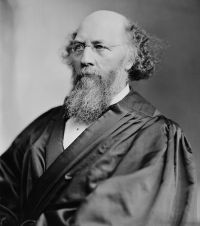
Portrait of Stephen Johnson Field Stephen Johnson Field Bridge Company v. United States…

I cannot admit that there is any such arbitrary power under our government. I find no warrant for it in the Constitution; on the contrary, all the guarantees which that instrument contains for the security of property negative its existence. Yet out of this assertion of a power to legalize a structure, which without such sanction would be deemed an obstruction to navigation, has grown up the doctrine of an independent power in Congress to authorize the construction of bridges over navigable streams without the permission of the States, and to control them when constructed.
Source: Wikisource

Portrait of Stephen Johnson Field Stephen Johnson Field Bridge Company v. United States…

Congress cannot invade the rights of a State, nor can a State impede the exercise of the just powers of the Federal government. The conclusion I draw is, that a bridge constructed by the authority of a State, if it does not interfere with the free navigation of the stream, is a lawful structure, and can neither be taken nor destroyed by Congress or by the State, except as other private property may be thus taken, that is, for public purposes upon making just compensation.
Source: Wikisource

Portrait of Stephen Johnson Field Stephen Johnson Field Bridge Company v. United States…

There are highways on land in every State, on which a far greater commerce, both inter-state and foreign, is conducted, than that which is borne upon its navigable waters. Congress can require that this commerce shall be as free from unnecessary obstruction as that on navigable waters connecting two or more States or leading to the sea. There is nothing in the Constitution which in any respect distinguishes the regulation it may exercise in either case.
Source: Wikisource

Get perspective with Kwize: daily news enlightened by great literature