Summary

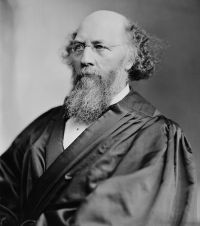
Portrait of Stephen Johnson Field Stephen Johnson Field Corbett v. Nutt — Opinion of the Court

The second clause provides that if the owner of the land sold be a minor, a non-resident alien, a loyal citizen beyond the seas, a person of unsound mind, or under a legal disability, the guardian, trustee, or other person having charge of the person or estate of such owner, may, in the same manner and with like effect, redeem the land at any time within two years after the sale.
By these provisions persons entitled to make redemption are divided into two classes. The first class embraces persons who are residents in the country, and are not laboring under any legal disability.
Source: Wikisource

Portrait of Stephen Johnson Field Stephen Johnson Field Corbett v. Nutt — Opinion of the Court

No people can exist without exchanging commodities. There must be buying and selling and exchanging in every community, or the greater part of its inhabitants would have neither food nor raiment. And yet the argument of the defendant, if good for anything, goes to this extent, that by the act of Congress 'all sales, transfers, and conveyances' of property of the vast numbers engaged in the late rebellion against the United States, constituting the great majority of many towns, and cities, and even of several states, were utterly null and void
Source: Wikisource

Portrait of Stephen Johnson Field Stephen Johnson Field Corbett v. Nutt — Opinion of the Court

But the additional oath imposed by the act of 1865 is, in our judgment, required only of owners seeking in person to redeem. It declares that 'no owner shall be entitled to redeem' unless he take the additional oath. If the requirement extended also to owners beyond the seas or laboring under legal disability, it could not in many cases be complied with, and the beneficial object of the act, which was to secure to them the right of redemption, would be defeated.
Source: Wikisource

Get perspective with Kwize: daily news enlightened by great literature