Summary

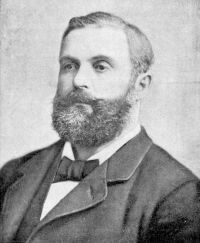
Portrait of Thomas Wallace Knox Thomas Wallace Knox The Boy Travellers in the Far East…

Near by were the rich fields of the Valley of the Nile, and now and then the shining water of the old river was revealed through openings among the fringe of palms; the mud-built villages of the Egyptians passed as in a panorama, the white walls of the houses of Cairo took the place of the more primitive structures, groups of men and camels, and other beasts of burden, were seen wending their way to the great city or returning from it.
Source: Gutenberg

Portrait of Thomas Wallace Knox Thomas Wallace Knox The Boy Travellers in the Far East…

Across the green fields, which were stippled with the white walls of palaces or dotted with the brown villages of the peasants, our gaze rested on the yellow desert, backed by the Libyan mountains which form the western horizon. From the edge of the desert the great pyramids rose in all their grandeur, and it was not difficult for us to realize their enormous proportions. From other points the pyramids had appeared to be almost on a level with the valley of the river, but as we viewed them from the Citadel we could see that they stood on a rocky platform fully a hundred feet in height.
Source: Gutenberg

Portrait of Thomas Wallace Knox Thomas Wallace Knox The Boy Travellers in the Far East…

It is at the place where the traveller from Tiberias gets his first view of Damascus, with its domes and minarets rising from the fertile plain—dotted with villages set in rich orchards, and gardens watered by the Pharpar and Abana, flowing down from the mountains which guard them. The life-giving power of water is seen nowhere in all Syria to better advantage than from this point, and it is no wonder that Naaman exclaimed, "Are not Pharpar and Abana, rivers of Damascus, better than all the waters of Israel?"
Source: Gutenberg

Get perspective with Kwize: daily news enlightened by great literature