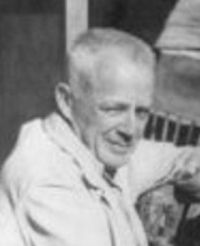
Vance Randolph

Vance Randolph

Summary

Portrait of Vance Randolph Vance Randolph Life Among the Butterflies (1925)

It is a fixed rule in science that the first man to discover and describe a species has the right to name it, and that whatever name he chooses shall be used by everybody forever, but scientists are only human after all, and are always anxious to discover new species and name them after their friends or sweethearts. It often happens that a single species is described independently by several authors, each of which applies a name of his own devising
Source: Gutenberg

Portrait of Vance Randolph Vance Randolph Life Among the Butterflies (1925)

When the Mourning Cloak alights upon the ground, or upon a log, it closes its wings and becomes well-nigh indistinguishable from its surroundings, because the under side of the wings is protectively colored. Now, if the body lies at right angles to the sun’s rays, the wings cast a large shadow, much more conspicuous than the butterfly itself, and hence attracting unfriendly eyes to the butterfly. If however the body is in line with the rays of light, and the wings brought together vertically, the shadow is insignificant.
Source: Gutenberg

Portrait of Vance Randolph Vance Randolph Life Among the Butterflies (1925)

It is certainly a great advantage for a harmless insect to resemble some dangerous and inedible species, and the whole phenomenon of resemblance has been called protective mimicry.
The best example of mimicry in American butterflies is the case of the Monarch (Anosia plexippus) and the Viceroy (Basilarchia disippus) . The Monarch belongs to the subfamily Euploeinae, all the members of which are provided with secretions which render them distasteful to birds and predaceous insects. The Monarch advertises its inedibility by its bright brown and black wings, and its leisurely manner of flight.
Source: Gutenberg

Get perspective with Kwize: daily news enlightened by great literature