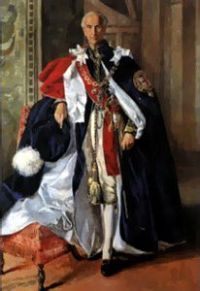
Victor Bulwer-Lytton

Victor Bulwer-Lytton

Summary

Portrait of Victor Bulwer-Lytton Victor Bulwer-Lytton Report of the Commission of Enquiry (1932)

Deep in the mind of every Japanese is the memory of their country's great struggle with Russia in 1901–05, fought on the plains of Manchuria, at Mukden and Liaoyang, along the line of the South Manchuria Railway, at the Yalu River, and in the Liaotung Peninsula. To the Japanese the war with Russia will ever be remembered as a life-and-death struggle fought in self-defence against the menace of Russian encroachments.
Source: Wikisource

Portrait of Victor Bulwer-Lytton Victor Bulwer-Lytton Report of the Commission of Enquiry (1932)

No foreign Power could develop Manchuria or reap any benefit from an attempt to control it without the good-will and wholehearted co-operation of the Chinese masses which form the bulk of the population, tilling its soil, and supplying the labour for practically every enterprise in the country. Neither will China ever be free from anxiety and danger unless these Northern Provinces cease to afford a battleground for the conflicting ambitions of neighbouring Powers.
Source: Wikisource

Portrait of Victor Bulwer-Lytton Victor Bulwer-Lytton Report of the Commission of Enquiry (1932)

In China, too, as thoughtful men have come to recognise that the vital problem, the real national problem, for their country is the reconstruction and modernisation of the State, they cannot fail to realise that this policy of reconstruction and modernisation, already initiated with so much promise of success, necessitates for its fulfilment the cultivation of friendly relations with all countries, and above all with that great nation which is their nearest neighbour.
Source: Wikisource

Get perspective with Kwize: daily news enlightened by great literature