Summary

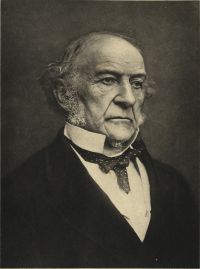
Portrait of W. E. Gladstone W. E. Gladstone Studies on Homer and the Homeric Age…

Such as we have seen, and so glorious, was the wisdom, and the valour, and the beauty, and the power, that dwelt in man; but only that through life he might, upon the whole, be paramount in woe above all meaner creatures, and then that he might die in a gloom unrelieved by hope. None have illustrated this piercing truth by contrasts so sharp as Homer, between the chill and dismal tone of the general destiny of man on the one hand, and on the other, the joy and cheerfulness which the effort of an elastic spirit can for a time create.
Source: Gutenberg

Portrait of W. E. Gladstone W. E. Gladstone Studies on Homer and the Homeric Age…

Yet, even while all this was so, there lay in the accumulating mythology the thickly scattered seeds of destruction, both for belief and for duty. How could marriage continue single, pure, or permanent, in the face of the promiscuous lusts of Jupiter? Why should not helpless infants be exposed, when Juno, disgusted with the form of Vulcan, threw him down into the sea? Why should not man make a joyous spectacle of blood and wounds, when they were already beheld with amusement by the highest of the gods?
Source: Gutenberg

Portrait of W. E. Gladstone W. E. Gladstone Studies on Homer and the Homeric Age…

Such an account I have endeavoured to supply in treating of Iris, by shewing that she owes her place to a primeval tradition, while Mercury owes his to an ideal conformity with the laws of the Olympian system.
And in truth there is no single deity, on whom the stamp of that system has been more legibly impressed. It might be said of the Homeric Mercury, that he exceeds in humanism (to coin a word for the purpose) the other Olympian gods, as much as they excel the divinities of any other system. His type is wholly and purely inventive, without a trace of what is traditional.
Source: Gutenberg

Get perspective with Kwize: daily news enlightened by great literature