Summary

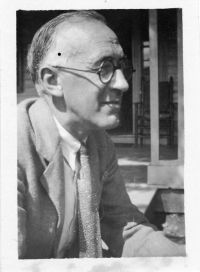
Portrait of Walter Prichard Eaton Walter Prichard Eaton Boy Scouts in the White Mountains…

Peanut tried shouting, to get an echo, but his voice sounded so small and foolish in this great, yawning hole of shadows in the mountainside, that he grinned rather sheepishly, and shut up.
The “baby glacier,” as Rob called the snow-drift, was like a white shadow at the foot of the head wall. They could hear the brook tinkling beneath it, but not so loud as by day. When the sun goes down, the melting stops to a very considerable extent. And it was very cold near the icy bank. The boys shivered, and turned back toward camp.
Source: Gutenberg

Portrait of Walter Prichard Eaton Walter Prichard Eaton Boy Scouts in the White Mountains…

The north peaks were all out, and the great shoulder of Chandler Ridge on Washington, across the white mists which filled the Great Gulf, looked like a stone peninsula thrusting out into a foamy sea. There was only a slight wind, and the sun was pleasantly warm already.
“How’s the grub holding out?” asked Mr. Rogers. “If we have breakfast cooked for us inside, it will cost us something. Have we enough left for breakfast and lunch? We’ll have to get supper on the train.”
“Train! Gee whiz, I don’t want to go home! Let’s stay another week,” said Frank.
“That’s the talk!” Peanut cried.
Source: Gutenberg

Portrait of Walter Prichard Eaton Walter Prichard Eaton Boy Scouts in the White Mountains…

They could see for miles, even to the blue ramparts of Lafayette and Moosilauke in the west and southwest. Directly south they looked over a billowing sea of mountains and green, forest-covered valleys, a wilderness in which there was no sign of human beings. To their left was the deep hole of Tuckerman’s Ravine, gouged out of the solid rock. Only the very summit of Washington behind them still wore a hood of white vapor.
Source: Gutenberg

Get perspective with Kwize: daily news enlightened by great literature