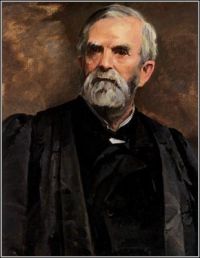
William Burnham Woods

William Burnham Woods

Summary

Portrait of William Burnham Woods William Burnham Woods Missionary Society of Church v…

The reasons which induced the abandonment of the lands by the missionary societies whether a new policy on the part of the appellant, or fear of the Indians on the part of the American Board-are entirely immaterial. When the lands were abandoned for any reason all right in them was lost, and they were open to the occupancy of any one who might choose to take and hold them. The method adopted by the appellant to turn over the station to the American Board by an actual transfer of possession was as effectual as any could be.
Source: Wikisource

Portrait of William Burnham Woods William Burnham Woods Missionary Society of Church v…

The act of August 14, 1848, confirms and establishes title to land occupied at the date of the act as missionary stations among the Indian tribes. The words are 'now occupied.' To occupy means to hold in possession; to hold or keep for use; as, to occupy an apartment. Webst. Dict. The appellant contends that this act confers title on it for lands which it did not occupy at the date of the act, but which it had voluntarily abandoned 11 months before, and the occupancy of which it never resumed, either for missionary or any other purposes.
Source: Wikisource

Portrait of William Burnham Woods William Burnham Woods Missionary Society of Church v…

It follows that there could be no constructive possession of the public lands. When, therefore, in August, 1847, the appellant voluntary abandoned its possession of the lands in controversy to another missionary society it lost every shadow of claim thereto. Its right was a mere possessory right, without other title. It had no rights which it could reserve. When the American Board, in December, 1847, abandoned the lands in controversy the appellant had no rights therein.
Source: Wikisource

Get perspective with Kwize: daily news enlightened by great literature