Summary

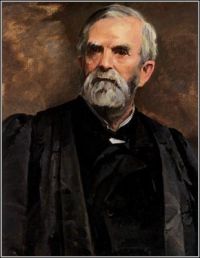
Portrait of William Burnham Woods William Burnham Woods Stow v. Chicago — Opinion of the Court

All, therefore, that there is left for the invention described in the first and third claims to cover is the making of the lower ends of a portion of the blocks of which the pavement is composed in wedge shape, and the driving of these wedge-shaped blocks below the general under-surface of the pavement into the sand or earth-bed on which it rests, so as to pack it and render it solid and unyielding.
Source: Wikisource

Portrait of William Burnham Woods William Burnham Woods Stow v. Chicago — Opinion of the Court

When the octangular block paving is used for acclivities, I should recommend the before-mentioned cavities either to be left unfilled or not filled up to the surface, to afford an assistance to animals ascending the same as before described.' It is true that this specification does not in terms say that the purpose of driving the wedge-shaped block or pile through the space left by the octagonal blocks is to pack the earth or sand foundation, but that it does so as effectually as the use of similar blocks in a similar way under the patent of appellant, is too clear for argument.
Source: Wikisource

Portrait of William Burnham Woods William Burnham Woods Stow v. Chicago — Opinion of the Court

The claim is as follows: 'A pavement composed of blocks laid in rows directly upon the sand foundation with spaces between the rows filled with sand or gravel, which is swaged or driven into said foundation, substantially as and for the purpose specified.'
The use of wood for street pavements, the laying of the blocks directly upon a sand foundation, the placing of the blocks in rows, leaving spaces between the rows, are all old devices.
Source: Wikisource

Get perspective with Kwize: daily news enlightened by great literature