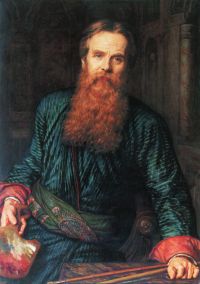
William Holman Hunt

William Holman Hunt

Summary

Portrait of William Holman Hunt William Holman Hunt The triumph of the innocents (1885)

But in this English picture all the story of the escape, as of the flight, is told, in fulness of peace, and yet of compassion. The travel is in the dead of the night, the way unseen and unknown;—but, partly stooping from the starlight, and partly floating on the desert mirage, move, with the Holy Family, the glorified souls of the Innocents. Clear in celestial light, and gathered into child-garlands of gladness, they look to the Child in whom they live, and yet, for them to die.
Source: Gutenberg

Portrait of William Holman Hunt William Holman Hunt The triumph of the innocents (1885)

During the spring-time, rich in flowers and first-fruits, the Holy Travellers are represented as passing across the Philistine plain on the road to Gaza at a distance of about thirty miles from their point of departure. The night is far spent. While the declining moon sheds its last rays on the natural objects in the picture, unearthly light reveals the embodied spirits of the martyred Innocents advancing in procession.
The Virgin is seated on a she-ass of the breed now known as the Mecca race, and the foal follows its mother, as is seen to this day in the East.
Source: Gutenberg

Portrait of William Holman Hunt William Holman Hunt The triumph of the innocents (1885)

The foal accompanies the mother ass, in a long journey the young creature lags behind whinnying in remonstrance at the ceaseless steps, and only hurrying on in bounds when there is fear of the parent ass getting beyond reach and sight. The glorified infants are encircling the weary laggard, who is thus brought up to the onward group. The wild dogs which have come out of the mill-house to bark—as is their wont with nocturnal travellers striving to pass a homestead in silence—are cowed at the unusual apparition and steal away in fear.
Source: Gutenberg

Get perspective with Kwize: daily news enlightened by great literature