Summary

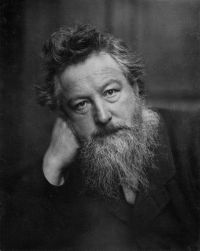
Portrait of William Morris William Morris News from Nowhere — Chapter X: QUESTIONS AND ANSWERS (1890)

England was once a country of clearings amongst the woods and wastes, with a few towns interspersed, which were fortresses for the feudal army, markets for the folk, gathering places for the craftsmen. It then became a country of huge and foul workshops and fouler gambling-dens, surrounded by an ill-kept, poverty-stricken farm, pillaged by the masters of the workshops. It is now a garden, where nothing is wasted and nothing is spoilt, with the necessary dwellings, sheds, and workshops scattered up and down the country, all trim and neat and pretty.
Source: Wikisource

Portrait of William Morris William Morris News from Nowhere — Chapter X: QUESTIONS AND ANSWERS (1890)

In the old times all this was the result of poverty. In the nineteenth century, society was so miserably poor, owing to the systematised robbery on which it was founded, that real education was impossible for anybody. The whole theory of their so-called education was that it was necessary to shove a little information into a child, even if it were by means of torture, and accompanied by twaddle which it was well known was of no use, or else he would lack information lifelong: the hurry of poverty forbade anything else.
Source: Wikisource

Portrait of William Morris William Morris News from Nowhere — Chapter X: QUESTIONS AND ANSWERS (1890)

The life that goes on in these big dwellings in the country is very pleasant, especially as some of the most studious men of our time live in them, and altogether there is a great variety of mind and mood to be found in them which brightens and quickens the society there."
"I am rather surprised," said I, "by all this, for it seems to me that after all the country must be tolerably populous."
"Certainly," said he; "the population is pretty much the same as it was at the end of the nineteenth century; we have spread it, that is all.
Source: Wikisource

Get perspective with Kwize: daily news enlightened by great literature