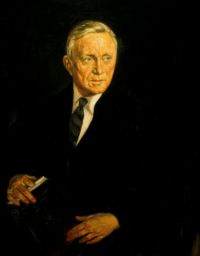
William O. Douglas

William O. Douglas

Summary

Portrait of William O. Douglas William O. Douglas Picard v. Connor — Dissent

The judges to whom that issue of law is tendered are learned men who we must assume are knowledgeable as to the meaning of due process. A law student who tendered a brief that left due process at large would certainly not be worthy of an 'A.' But the nicety of analysis which we associate with scholarship has no functional role to play in this area of exhaustion of state remedies. When we go to that extreme, we make a trap out of the exhaustion doctrine which promises to exhaust the litigant and his resources, not the remedies.
Source: Wikisource

Portrait of William O. Douglas William O. Douglas Picard v. Connor — Dissent

Its vulnerability tested by due process was as obvious when the case was before the Supreme Judicial Court of Massachusetts as it now is. I think the Court of Appeals acted responsibly in ruling on it. We should decide the merits here and now. Endless repetitive procedures are encouraged by today's ruling on exhaustion of remedies. I would bring this litigation to an end today by applying the exhaustion-of-remedy rule to terminate rather than multiply procedures that now engulf the state-federal regime.
Source: Wikisource

Portrait of William O. Douglas William O. Douglas Picard v. Connor — Dissent

Daugharty was an indigent state prisoner. He appealed the denial of state habeas corpus to the intermediate state appellate court, but that court dismissed the appeal because Daugharty could not afford to supply an appellate transcript. He then moved the state supreme court for an order requiring that he be supplied a transcript free of charge, and when that motion was denied, sought federal habeas corpus. The District Judge denied the application for a writ on the grounds Daugharty had failed to exhaust state remedies.
Source: Wikisource

Get perspective with Kwize: daily news enlightened by great literature