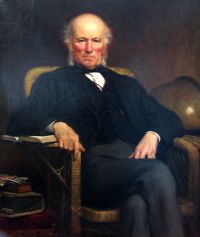
William Pengelly

William Pengelly

../../ (1862)

Summary

Portrait of William Pengelly William Pengelly,  ../../ (1862)

“ May we not regard them as so many tints intermediate, both in place and quality, between the extreme bands of the rainbow, uniting them into one beautifully graduated chromatic spectrum, so softly blending as to render it impossible to define the exact place of lines of demarcation, which, perhaps, have not, and never would have been supposed to have, an existence, had not observers hastily generalized from the imperfect evidence obtained during a period of colour blindness? ”
Source: Wikisource

Portrait of William Pengelly William Pengelly,  ../../ (1862)

“ The single articulated class, Crustacea, is by no means rich in any way; with one exception, all its genera are Trilobites, and commonly contain but one species each. The most important class numerically is Brachiopoda, to which one hundred and eight species belong, that is, thirty-one per cent, of the entire series. The families and genera of Cephalopoda are richer in species than those of any other class, averaging sixteen for each family, and ten for each genus. ”
Source: Wikisource

Portrait of William Pengelly William Pengelly,  ../../ (1862)

“ Though, as we have seen, the test entirely fails, at least so far as Devonshire is concerned, on which scepticism respecting the existence of a Devonian period has been founded, namely, "that the blending of Silurian and Carboniferous corals is of common occurrence," yet if the word "fossil" is substituted for "coral," a blending of the kind certainly does occur, and doubtless the fact is not without a meaning. Eight species from the preceding period, and fifty-eight from the succeeding—a total of sixty-six—meet in Devon and Cornwall. ”
Source: Wikisource

Get perspective with Kwize: daily news enlightened by great literature