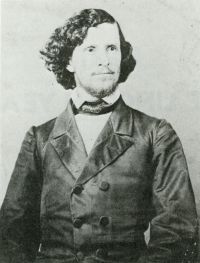
William Turner Coggeshall

William Turner Coggeshall

Summary

Portrait of William Turner Coggeshall William Turner Coggeshall The Poets and Poetry of the West… (1860)

We suppose ourselves to be throwing no shade of disparagement upon any one in declaring that, in "Singing Sybil" (Miss Fuller's nom de plume) , and her not less gifted sister Frances, we discern more unquestionable marks of true genius, and a greater portion of the unmistakable inspiration of true poetic art than in any of the lady minstrels—delightful and splendid as some of them have been—that we have heretofore ushered to the applause of the public.
Source: Wikisource

Portrait of William Turner Coggeshall William Turner Coggeshall The Poets and Poetry of the West… (1860)

Who can bear the sweet anguish of Heaven's pure fire?
Who will drug his own soul with despair?—
The roses whose odors wake endless desire,
The poppies of dreams, who can bear?
If he seeks but the bliss that perfumeth the top,
If he seeks but its sweetness divine.
Let him leave it, for anguish and joy, drop for drop,
Are expressed in this exquisite wine.
The lips that have thrilled at the goblet flow fast
With a madness they cannot forbear :
The gods what they will of the future and past
Through these oracles boldly declare.
Source: Wikisource

Portrait of William Turner Coggeshall William Turner Coggeshall The Poets and Poetry of the West… (1860)

Griswold's volume of "Female Poets," took occasion to refer to Miss Fuller as among the "most imaginative" of our lady poets. The poems above named are characterized by a power of diction and individuality in conception which give them the force of imaginative creations; but we are disposed to think her genius is not representatively "imaginative" according to Poe's definition of that word. She has that self-reliant spirit and clearness of perception which betray power and practicality—if we may be permitted the use of such a word in speaking of true poetry
Source: Wikisource

Get perspective with Kwize: daily news enlightened by great literature