“ Adolphine enjoyed showing Cateau Floortje's trousseau, with its stacks of linen. Adolphine attached more importance to her own house, her own children, her own furniture, her own affairs, matters and things than to anything else in the world. She was never tired of displaying, for the extorted admiration of the sister or friend who came to visit her, the thickness of her carpets, the heaviness of her curtains, the taste with which she had arranged the ornaments in her drawing-room ”
Adolphine
Definition and stakes
The theme of “Adolphine” has been addressed by authors such as Louis Couperus and Paul de Kock. It is often associated with terms like Adeline, love, Adolphus, Adolphe and Adelaide.
Quotes about “Adolphine”
 Louis Couperus,
Small Souls
(1919)
Louis Couperus,
Small Souls
(1919)
“ For she wanted the sister or friend to realize, above anything else, that in her, Adolphine’s, life everything was of the best and finest kind: things animate and inanimate, things movable and immovable alike. Adolphine’s cook, the sister or friend was assured, cooked better than any other cook, especially than Bertha’s cook; Adolphine’s dog, a pug, was the sweetest pug of all the pugs in the world. ”
“ And, notwithstanding her raging headache, she was filled with pity, because Adolphine was her sister. She rose and went to Adolphine:"Phine," she said, frankly, "don't be angry if I am not very talkative, but I have such a headache. And I really do think it nice of you to look me up. Come often. Let us see a lot of each other. I only came to the Hague because of you all. I wanted you so badly. I have dragged through so many dreary years. I have no one in my life, except my boy. And he is still so young; and I tell him too much as it is. I have been very unhappy, Adolphine, Phine. ”
“ Her very husband thwarted her: a simple man, a little boorish in his ways, who trudged daily to his office and back, conscientious about his work like a schoolboy finishing his exercises and devoid of any particular ability or political adroitness. He approved of what Adolphine did, but could not understand that craving, that vital need of hers for distinction. It was true that he had caught from his wife that exuberant satisfaction with his wife, his house, his children, his furniture and his friends. He too knew how to boast of his coat, his office, even his minister, his secretary-general. ”
Louis Couperus,
Small Souls
(1919)
“ And she was so afraid that Addie might catch some of it. . . . Poor Adolphine, what a struggle, especially with all Bertha’s unattainable perfection before her eyes! For they all suffered from jealousy in their family: she had it herself; and Adolphine had always had it very strongly-developed from a child: jealous of her elder sisters and brothers. . . . Would she ever be able to give Adolphine a word of advice? Now that Floortje’s wedding was near at hand, couldn’t she be of use to Adolphine? She thought it such a pity that her sister—a Van Lowe, after all—was becoming so common ”
 Paul de Kock,
Monsieur Cherami
Paul de Kock,
Monsieur Cherami
“ Why should Monsieur Gustave fight for her, I should like to know, when she keeps making sport of him? A man doesn't fight, except for a person he loves; and I am very sure, for my part, that Monsieur Gustave never gives your sister a thought now.""You think not, Madeleine?"This question was asked with an eagerness which would have betrayed Adolphine's secret, if her maid had not already guessed it."But Fanny isn't married!" murmured Adolphine sadly, a moment later."Well, mamzelle, for my part, I am glad of it! She'd have kicked up altogether too much dust if she had been a countess." ”
William Pitt Scargill, Blue-Stocking Hall, (Vol. 2 of 3…
“ While others pursue the 'bubble reputation' abroad, Adolphus seeks to be loved at home, and his own fire-side is the scene in which the best energies of his mind, and the purest affections of his heart are expanded. I am reclaimed by his virtues from my visionary absurdities, and shall endeavour to make all the reparation in my power for having wandered so far from the truth by preaching a crusade to the youth of my own sex, who may be inclined to deviate into the labyrinth from which I was myself so happily extricated. ”
 Georg Brandes,
Main Currents in Nineteenth Century Literature - 1…
Georg Brandes,
Main Currents in Nineteenth Century Literature - 1…
“ Adolphe is woman's Werther. The passion and melancholy of the new age have advanced another step; they have spread to the other sex. In Werther it was the man who loved, suffered, stormed, and despaired; in comparison with him the woman was sound, strong, and unharmed—perhaps a trifle cold and insignificant. But now it is her turn, now it is she who loves and despairs. In Werther it was the woman who submitted to the laws of society, in Adolphe it is the man who does so. The selfsame war waged by Werther in the name of his love is now waged by Eléonore, and with equally tragic result. ”
 Honoré de Balzac,
The Muse of the Department
Honoré de Balzac,
The Muse of the Department
“ Adolphe is a man of birth, an aristocratic nature, who wants to get back into the highroad to honors and recover his social birthright, his blighted position. You, at this moment, are playing both parts. You are suffering from the pangs of having lost your position, and think yourself justified in throwing over a hapless lover whose misfortune it has been that he fancied you so far superior as to understand that, though a man's heart ought to be true, his sex may be allowed to indulge its caprices. ”
 G. P. R. James,
The Castle of Ehrenstein
G. P. R. James,
The Castle of Ehrenstein
“ Strange, strange must be the constitution of those minds who prefer reverence to affection. Words of course, formal courtesies, were all that passed between the Lady Adelaide and her visitor, and although Heaven knows the poor girl had little pride in her nature, and her heart was as gentle as the summer air, yet such was the influence of the Countess's manner upon her that she became cold and almost haughty in demeanour. ”
Stephen Crane, The Revenge of the Adolphus
“ Probably there entered the mind of every man on board of the Adolphus a feeling of almost idolatry for this living thing, stern, but, to their thought, incomparably beautiful. They would have cheered but that each man seemed to feel that a cheer would be too puny a tribute. ”
Georg Brandes,
Main Currents in Nineteenth Century Literature - 1…
“ Unlike former love stories, Adolphe does not delineate love only in its first awakening in the dawn of delusive hopes, but follows it through its whole existence, depicts its growth, its strength, its decay, its death, and even pursues it to the other side of the grave and shows the feelings into which it is transformed. Hence Adolphe, even more than René, is the story of the individual's rude awakening from delusion, the representation of the anguish of disappointment. It is the flower of life which is here stripped of its petals one by one and carefully dissected. ”
Lady Charlotte Campbell Bury, The Exclusives (vol. 2 of 3)
“ Lady Adeline is, possessed of charms of person which would indeed draw any heart towards her, of the warmest and most enthusiastic disposition, deeply enamoured of you as well as sacredly alive to her engagement to you (and I know her, from a source which cannot mislead me, in person, in mind, in heart, and in determination, to be all that I describe to you) —how could even your judgment, Lord Albert, which is stronger than many of twice your years, but yield to such united influence, and be tempted to decide at the moment on making so much perfection irrevocably your own. ”
 Anthony Hope,
The King's Mirror
(1899)
Anthony Hope,
The King's Mirror
(1899)
“ The shock of him was passing over; he was falling into focus with the rest of it; but she was not becoming in the least fonder of him. I knew all this without the few words; with them he knew none of it. It seems to be a mere accident who chances to be previous to truth, who impervious. In loneliness for me, in perturbation for poor William Adolphus, in I know not what for Victoria the time passed on. There is but one incident that stands out, flaming against the gray of that monotony. ”
Honoré de Balzac,
Petty Troubles of Married Life…
“ Adolphe is kindness itself to me; I admire and love him. But, my dear, in this complete happiness lurks a thorn. The roses upon which I recline have more than one fold. In the heart of a woman, folds speedily turn to wounds. These wounds soon bleed, the evil spreads, we suffer, the suffering awakens thoughts, the thoughts swell and change the course of sentiment."Ah, my dear, you shall know all about it, though it is a cruel thing to say—but we live as much by vanity as by love. To live by love alone, one must dwell somewhere else than in Paris. ”
Georg Brandes,
Main Currents in Nineteenth Century Literature - 1…
“ She is carefully described by the author as being such that Adolphe's love for her, however strong, is certain sooner or later to be affected by social considerations. In the first place, Adolphe is not the only man she has loved, and the verdict of society has been passed upon her before they meet; she is not his equal in its eyes, although she is so by birth. ”
Honoré de Balzac,
Analytical Studies
“ Adolphe, rejoicing in the deceptions which have fallen upon me like a hail-storm, smoothes over the wounds in my self-love by so much affection, so many attentions, and such charming things, that, in good truth, women—so far as they are simply women—would be glad to find in the man they marry defects so advantageous. But all men of letters (Adolphe, alas! is barely a man of letters) , who are beings not a bit less irritable, nervous, fickle and eccentric than women, are far from possessing such solid qualities as those of Adolphe, and I hope they have not all been as unfortunate as he. ”
Anthony Hope,
The King's Mirror
(1899)
“ It was not; after I had breakfasted Victoria sent William Adolphus to me. I am inclined now and then to think that there is, after all, something mystic in the status of husbandhood, some supernatural endowment that in the wife's eyes attaches to her own man, however little she values him, at however low a rate she sets his natural qualities. How otherwise could Victoria (whose defect was more in temper than in perception) send William Adolphus to talk to me? He came; the rôle of the man of the world was his choice. ”
Anthony Hope,
The King's Mirror
“ Going to Victoria, I saluted her with brotherly heartiness. I never allowed myself to forget that Victoria was very fond of me, and I never lost my affection for her."Now don't be foolish, Augustin," she implored."What is being foolish?" I asked perversely."Oh, you know! You know very well what people say, and so do I.""And poor old Hammerfeldt in heaven—does he know too?"She turned away with a shocked expression. William Adolphus hid a sheepish smile with a large hand. In the lower ranges of humour William Adolphus sometimes understood one. ”
Anthony Hope,
The King's Mirror
(1899)
“ But I was wondering whether I should be justified in lending countenance to these distractions of William Adolphus. The Frenchman's quick wit overtook my thoughts. "If you wish to rescue the Prince from danger, sire," he said, laughing, "you can't do better than come often." ”
Honoré de Balzac,
Analytical Studies
“ Be that as it may, my dear, Adolphe is always warmly welcomed when he comes back home. Still, no nature is strong enough to await always with the same ardor. What a morrow that will be, following the evening when his welcome is less warm! “Now do you see the depth of the fold which I mentioned? A fold in the heart is an abyss, like a crevasse in the Alps—a profundity whose depth and extent we have never been able to calculate. Thus it is between two beings, no matter how near they may be drawn to each other. One never realizes the weight of suffering which oppresses his friend. ”
 Ann S. Stephens,
The Indian queen
Ann S. Stephens,
The Indian queen
“ You came between me and all that makes life endurable—you trailed the venom of your smile over every hope of my heart—you usurped my place in the house of my father—you made me an outcast, an alien, and then dared to insult me by offering your pity to her you called the ‘poor half-breed!’”“Had you been my own sister, I could not have loved you more fondly,” returned Adèle. ”
Frances Freeling Broderip, Tales of the Toys, Told by Themselves
“ Here, thought I, am I placed in my natural sphere, a dweller with the fair and the noble, surrounded with rank and beauty, and breathing only the refined air of higher life. I was cut short in my musings by Lord Adolphus, the youngest son of the Duchess, who, with the charming vivacity so natural to his birth and station, abstracted me from the dainty basket in which I reposed, with a few companions of less merit. ”
Lady Charlotte Campbell Bury, The Exclusives (vol. 3 of 3)
“ But, notwithstanding all Lady Adeline's amiable qualities, and all the estimable motives of her conduct, she could not avoid the natural pangs of sorrow and anxiety, which she, in common with every human being, is doomed to experience. Come they must in some shape or other to all; happiest are those who entertain them wisely. The whole of that day, an ebb and flow of dread and doubt passed over her in alternate tides of hope or despondence;—of doubt, if Lord Albert would again call,—of dread, lest, if he did call, she should betray herself to him ”
Robert Jephson, The Count of Narbonne: A Tragedy…
“ Enter Adelaide, Jaqueline following. Jaq. Where do you fly? Heavens! have you lost all sense? Adel. Oh, 'would I had! for then I should not feel; But I have sense enough to know I am wretched, To see the full extent of misery, Yet not enough to teach me how to bear it. Jaq. I did not think your gentleness of nature Could rise to such extremes. Adel. Am I not tame? What are these tears, this wild, dishevel'd hair? Are these fit signs for such despair as mine? Women will weep for trifles, bawbles, nothing. ”
Georg Brandes,
Main Currents in Nineteenth Century Literature - 1…
“ Adolphe's chivalrous feeling impels him to run away with her, and for a time their tender feeling towards each other resembles love. Eléonore makes fresh sacrifices which it galls Adolphe to accept. At one time she suffers as much from not being loved as he from not loving; at another she so intoxicates herself with her own passion that she sees it double and believes that it is returned. Both live in the memory of their former happiness, which is vivid enough to make parting seem painful, even impossible, but not strong enough to impart any happiness to their daily life. ”
Numerous, Gothic Stories (1800)
“ I mingled in their company, and in the lineaments of the courteous youth recognised the inconstant Edwin. O gentle lady, may heaven so help me in my utmost need, as I now speak the words of truth! And may the saints and holy angels so succour thee as thy mishap requires! The faithless youth hath committed treason against thy love. Seduced by the blandishment of an artful dame, he hath become forgetful of thy peerless beauty.” The heart of Adela throbbed with anguish during the recital. “Valorous heroic warrior!” ”
 John Philip Kemble,
Twelfth Night; or, What You Will
John Philip Kemble,
Twelfth Night; or, What You Will
“ But 'tis that miracle, and queen of gems, That nature pranks her in, attracts my soul.Vio. But, if she cannot love you, sir?Duke. I cannot be so answered. [pg 31] Vio. Sooth, but you must. Say, that some lady, as, perhaps, there is, Hath for your love as great a pang of heart As you have for Olivia: you cannot love her; You tell her so: Must she not then be answered?Duke. There is no woman's sides, Can bide the beating of so strong a passion As love doth give my heart:—make no compare Between that love a woman can bear me, And that I owe Olivia. ”
Various, The Atlantic Monthly (1858)
“ She's not the same now. I can see it. Strange if I could not! Young people are different from old. I thought this place would never seem like home to me, but I found out my mistake." "I knew you would," said Adolphus, quickly. "Of course it is the place for me, on the prisoner's account. I hate the prison just the same, though. But if I was mistaken, so was Elizabeth. She thought it would seem like home to her;—it never has; it never will. But I do not think there is a chance of our being kept here long by poor Mr. Manuel. Adolphus, I am for Elizabeth's going home." ”
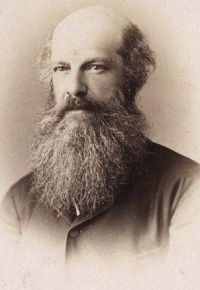 Laurence Oliphant,
Fashionable Philosophy, and Other Sketches
Laurence Oliphant,
Fashionable Philosophy, and Other Sketches
“ You have proved to me that your love for Adolphus, in the abstract, is as baseless and unsubstantial. I am not sorry under the circumstances that it should have been murdered, for it was a poor exotic. Let p. 148us not attempt to analyse the mysterious nature of that passion which is too precious a plant to tear up by the roots in order to discover the origin of its existence, but learn rather from this lesson, so painful to us both, that there are more things in heaven and earth than are dreamt of even in the philosophy of Comte, the doctrines of the æsthete, or the politics of Mr Gladstone. ”
