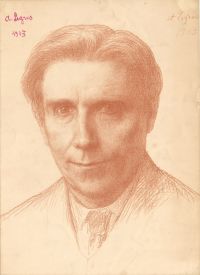
“ A tear trembled in each of the beautiful, gentle eyes of the old man, who had never wilfully soiled himself with an impure thought, who was full of the sweetness of charity. Benedetto was so deeply moved that he could not speak. ”
Benedetto
Definition and stakes
Benedetto emerges in literature as a multifaceted figure, shifting between spiritual passion and moral uncertainty. Antonio Fogazzaro portrays him as a saintly model in The Saint, merging medieval devotion with psychological complexity, while Jules Lermina depicts him as a tormented individual burdened by ghostly remorse in The Son of Monte-Cristo.
Alexandre Dumas, on the other hand, links Benedetto to conspiracy and retribution, reflecting the shadowy undertones of The Count of Monte Cristo. These diverse portrayals—spanning mystical dedication to profound despair—reveal Benedetto as an emblem of humanity’s conflict between salvation and downfall, shaped by the ethical and spiritual challenges faced by his creators.
Quotes about “Benedetto”
Jules Lermina,
The Son of Monte-Cristo
“ Why did not Benedetto turn aside, either to the right or the left? He could not; something stronger than his will drew him toward the nameless Thing. Finally Benedetto laid his hand on the shoulder of the Thing. It turned and lifted its head. Then an appalling shriek, which was like nothing human, came from Benedetto's lips. This spectre was that of his mother, whom he had stabbed in the breast at Beausset so many years before. ”
“ Benedetto, the Saint, is a new character in fiction, a mingling of St. Francis and Dr. Dollinger, a man of to-day in intelligence, a medieval in faith. Nothing could be finer than the way in which Signor Fogazzaro depicts his zeal, his ecstasies, his visions, his depressions, his doubts; shows the physical and mental reactions; gives us, in a word, a study in religious morbid psychology—for, say what we will, such abnormalities are morbid—without rival in fiction. We follow Benedetto’s spiritual fortunes with as much eagerness as if they were a love story. ”
The Mirror of Taste, and Dramatic Censor…
“ Ay, ay! good luck to you! and now I’ll seek my lord with this letter. So, so, my reverend father Cœlestino!—a convent of nuns under your direction! only separated by a party-wall!—ha, ha! that looks to me very much as if—hush, hush, signor Benedetto! what you are saying is not quite so charitable as it should be! bless my heart, bless my heart, how naturally is a man disposed to think the worst he can of his neighbours! ah, fy upon you, Benedetto ”
Alexandre Dumas,
The Count of Monte Cristo
(1888)
“ It was subsequently to these dreadful events that I waited on your excellency, to whom it would have been folly to have mentioned Benedetto, since all trace of him seemed entirely lost, or of my sister, since she was dead. ”
“ They had seen Giovanni Selva at Jenne. Was Benedetto acquainted with his works? Did he approve of cardinals being forbidden to go out on foot, and of priests not being allowed to ride a bicycle? What was his opinion of the Bible, and what did he believe concerning its inspiration? Before answering, Benedetto looked steadily and severely at his young interlocutor. “A physician,” he began at last, “was reputed to be able to cure all diseases. A man, who did not believe in medicine, went to him out of curiosity, to question him about his art, his studies, his opinions. ”
Jules Lermina,
The Son of Monte-Cristo, Volume I
“ It was not I suppose in the lawsuits you had against Andrea Cavalcanti, alias Benedetto? Yes? But do you know what I have heard? Benedetto is said to have escaped from Toulon. Take care of him; if there is a tiger in human shape, it is surely Benedetto!""I know it, Monsieur Beauchamp," replied the count, reluctantly; "Benedetto is the embodiment of evil principles—Satan in person! But one day I shall stretch out my hand and order him to stop—even if I have to go to the corners of the world to find him, he will not escape me." ”
“ Benedetto’s mystic fervour, his great and unconscious humility, his progress in comprehending the Faith according to the ideas originating with Signor Giovanni, a new lucidity of thought which flashed from him in conversation, the growing strength of their mutual affection, had awakened in him hopes of a revelation of Divine Grace, of Divine Truth, of Divine Power for the saving of souls, to be made, at no distant period, through this outcast of the world. They had said at the meeting at Signor Selva’s house, “A saint is needed.” ”
The Mirror of Taste, and Dramatic Censor…
“ Enter Benedetto.Ben. Why, Teresa! dawdling here, while the maids— Exit Teresa.Mi. Tis the same! how fortunate!—worthy old man—Ben. Is it you, father? why, you were out, when his excellence went this evening to—Mi. I was at home—but the prior’s suspicions—I was a prisoner; and—but this is no time for explanation—lead me to your lord! away.Ben. Impossible, father! all the grandees of Messina—a banquet, a ball—dont you hear the music? but doubtless tomorrow—Mi. Tomorrow will be too late! alas! perhaps it is too late already! perhaps at this very moment Venoni is no more! ”
“ There is an air of mystery, of intrigue, of secret messages passing to and fro—the atmosphere of craft which has hung round the ecclesiastical institution so many, many centuries. Few scenes in modern romance can match Benedetto’s interview with the Pope—he pathetic figure who, you feel, is in sad truth a prisoner, not of the Italian Government, but of the crafty, able, remorseless cabal of cardinals who surround him, dog him with eavesdroppers, edit his briefs, check his benign impulses, and effectually prevent the truth from penetrating to his lonely study. ”
“ Benedetto is persecuted not by an obviously brutal or sanguinary persecution,—although it might have come to that except for a catastrophe of another sort,—but by the very finesse of persecution. The sagacious politicians of the Vatican, inheritors of the accumulated craft of a thousand years, know too much to break a butterfly on a wheel, to make a martyr of an inconvenient person whom they can be rid of quietly. Therein lies the tragedy of Benedetto’s experience, so far at least as we regard him, or as he thought himself, an instrument for the regeneration of the Church. ”
“ But the sick man did not hear; he put his arm round Benedetto’s neck, drawing him to him, and continued his sorrowful confession, Benedetto repeating over and over again “My God, my God!” and making a mighty effort not to hear, but lacking the courage to tear himself away from the dying man’s embrace. And, in fact, he did not hear, nor would it have been easy to do so, for the words came so slowly, so brokenly, so confusedly. Still the parish priest did not appear, and Don Clemente did not return. ”
“ Benedetto’s appeal to the Pope to heal the four wounds from which the Church is languishing is a model of impassioned argument. The four wounds, be it noted, are the “spirit of falsehood,” “the spirit of clerical domination,” “the spirit of avarice,” and “the spirit of immobility.” The Pope replies in a tone of resignation; he does not disguise his powerlessness; he hopes to meet Benedetto again—in heaven! IV The Saint may be considered under many aspects—indeed, the critics, in their efforts to classify it, have already fallen out over its real character. ”
“ His talks with Giovanni Selva had brought him indirectly, and little by little, to feel thus regarding the monastic life in its present form, although he was convinced that it has indestructible roots in the human soul. But now, perhaps for the first time, he looked his belief squarely in the face. For a long time his wish and his hope had been that Benedetto might become a great gospel labourer; not an ordinary labourer, a preacher, a confessor, but an extraordinary labourer; not a soldier of the regular army, hampered by uniform and discipline, but a free champion of the Holy Spirit. ”
“ But as a servant of holy Truth, I say to you that harshness is not good, even when used towards one who deceives, because gentleness might perhaps bring him to repent of his deceit; and I say also, Padre, that in your words there is not the spirit of our true and; only Father, to whom be all glory!” At the words “to whom be all glory” Benedetto fell upon his knees, his face glowing with intense fervour. “Is it for you, miserable sinner, to play the part of teacher?” the Abbot exclaimed. ”
“ Here Benedetto paused, and gently begged Giovanni Selva to come nearer. “I wish to see you,” he said. “What I have said and, above all, what I am going to say, was born of you.” He stretched out his hand, and taking Don Clemente’s hand, he added: “The Father knows it. Each should feel God’s presence within himself, but each should feel it also in the other, and I feel it so strongly in you. ”
“ When Benedetto rose, and all gathered round him in a respectful circle, the old gentleman with the red face and the white hair rose also, and said, his voice shaking with emotion. “You will suffer insult and blows; you will be crowned with thorns and given gall to drink; you will be derided by the Pharisees and the heathen; you will not see the future you long for, but the future is yours ”
“ The murmur of the rain, the rumble of the deep Anio, would have meant to Jeanne the distressed lament of all that lives and loves in the world; to Don Clemente they meant the pious union of inferior creatures with the creature supplicating the common Father. Benedetto himself did not notice them. He rose, his face composed, and, in obedience to his master’s gesture, put on the robe of a lay-brother, which was spread out upon the bed, and fastened the leathern girdle. ”
“ Don Clemente made the habit his disciple had laid aside into a bundle. When it was folded he told Benedetto that he could not offer him the hospitality of Santa Scolastica; he had intended asking Signor Selva to take him in, but he now doubted if it would be opportune and in the interests of his mission for Benedetto to put himself so openly under the protection of Signor Giovanni. Benedetto smiled. “Oh! certainly not!” said he. “Shall we fear the darkness more than we love the light? But I must pray God to make His will known to me, if it be possible. ”
Rudyard Kipling,
Rewards and Fairies
“ I said. “I cannot die by choking, for I am just dubbed knight, Benedetto.” ‘“Tell me, and I’ll confess ye, Sir Harry Dawe, Knight. There’s a long night before ye. Tell,” says he. ‘So I told him—his chin on my crown—told him all; told it as well and with as many words as I have ever told a tale at a supper with Torrigiano. I knew Benedetto would understand, for, mad or sad, he was a craftsman. I believed it to be the last tale I’d ever tell top of mortal earth, and I would not put out bad work before I left the Lodge. All art’s one art, as I said. I bore Benedetto no malice. ”
Thomas Okey,
Venice and Its Story
“ Benedetto’s masterpiece, the Virgin Enthroned, an early work, is in the Accademia, No. 82. The much-disputed Christ at Emmaus in S. Salvatore has been attributed to him. Only scraps of the biographies of these two artists are known. The former was lame, and died in 1530; the latter once competed successfully with Carpaccio for the painting of a gonfalone for the Guild of Charity, of which he was a member, and died in 1525. ”
Jules Lermina,
The Son of Monte-Cristo, Volume I
“ Upon a wink from the [Pg 90] chaplain, who wore the dress of a Jesuit priest, the jailer departed, and after the priest had closed the door, he turned toward Benedetto, and said:"My son, thank God for his mercy, and try to show yourself worthy of it."Neither Madame Danglars nor the priest noticed the smile which flitted across the convict's face. Benedetto collected himself immediately, and taking off his hat he bent his knee to his mother and crossed his eyes with his hand. The priest sat in the window alcove, pulled a prayer-book out of his pocket and began to read ”
“ But, after all, I can easily understand that you do not wish to explain yourself to us, whom you believe to be reporters. To-day we are not—or at least I am not—in the state of mind you desire. I may be blind, but I do not feel inclined to ask the Pope for light, or a Luther either. Nevertheless, if you come to Rome, you will find young men better disposed than I am, than we are. Come, speak, let us also listen to you! To-day it is curiosity with us, to-morrow, who knows? we may feel the right spirit. Come to Rome!” “Give me your name,” said Benedetto. ”
“ The bells ceased, and Benedetto said gently to those nearest him: “Who are you, and what has happened that you come to me as if I were that which I am not?” Several voices answered at once; he was informed of the miracle, and of how he was wanted in this village and in that. “You exalt me,” said he, “because you are blind. If this girl is healed, not I have healed her, but her faith has made her whole. This power of faith, which has caused her to rise up and walk, is in God’s world, everywhere and always, like the power of terror, which causes us to tremble and fall down. ”
“ They awaited the priest’s return in silence. The Pontiff, lost in thought, never raised his eyes from the little table. Benedetto, standing, kept his eyes closed. He opened them when the priest reappeared. When he had passed out through the suspicious door, the Pope made a sign with his hand, and Benedetto spoke in a low voice. The Pontiff listened, grasping the arms of his chair, his body bent forward, his head bowed. “Holy Father,” Benedetto said, “the Church is diseased. Four evil spirits have entered into her body, to wage war against the Holy Spirit. One is the spirit of falsehood. ”
“ That Piero Maironi, a man of the world, cultivated far beyond his kind, after having had a vehement love-affair is stricken with remorse, “experiences religion,” becomes penitent, is filled with a strange zeal—an ineffable comfort—and devotes himself, body, heart, and soul to the worship of God and the succour of his fellow-men. As Benedetto, the lay brother, he serves the peasant populations among the Sabine hills, or moves on his errands of hope and mercy among the poor of Rome. Everybody recognises him as a holy man—“a saint.” ”
“ Therefore, when Don Clemente—following the parish priest’s advice—appealed to him, he had no difficulty in obtaining from him the promise of an old suit of black, a black tie, and a broad brimmed black hat, for Benedetto. In the room where the secular clothes were spread out, the disciple, having removed his habit, began to put them on in silence, and his master, who was standing at the window, could not repress a sob. Presently Benedetto called softly to him. “Padre mio,” said he, “look at me!” ”
“ Benedetto ceased speaking. There was an expression, of fervent appeal in the gaze fixed upon the Pope. “Well?” the Pontiff murmured. Benedetto spread wide his arms, and continued: “The Spirit urges me to say more. It is not the work of a day, but let us prepare for the day—not leaving this task to the enemies of God and of the Church—let us prepare for the day on which the priests of Christ shall set the example of true poverty; when it shall be their duty to live in poverty, as it is their duty to live in chastity ”
“ Benedetto sat down, exhausted, and was silent. There was a movement among the audience like the shuddering of waves surging towards him. Raising his hands, he stopped them. “Friends,” he said, in a weary, sweet voice, “listen to me once more. Scribes and Pharisees, elders and princes among priests, have striven in all times against innovations, as they strive to-day. It is not for me to speak to you of them; God will judge them. We pray for all those who know not what they do. But perhaps those of the other Catholic camp, the militant camp, are not entirely without sin. ”
Ouida,
Bimbi: Stories for Children
“ Now, Maestro Benedetto, having known some time, it seems, of this order, has had made in readiness several large oval dishes and beautiful big- bellied jars: he gives one of each to each of his pupils,—to myself, to Berengario, to Tito, and Zenone. The master is sorely distraught that his eyesight permits him not himself to execute the duke's commands; but it is no secret that should one of us be so fortunate as to win the duke's approbation, the painter who does so shall become his partner here and shall have the hand of Pacifica. ”