“ Dressed in an ordinary suit of Irish tweed, Bernard Clowes lay at full length in an easy attitude, his hands in his pockets and his legs decently extended as Barry, his male nurse, had left them twenty minutes ago: a big, powerful man, well over six feet in height, permanently bronze and darkly handsome, his immense shoulders still held back so flat that his coat fitted without a wrinkle—but a cripple since the war. ”
Quotes about “Clowes”
“ How had Clowes spent the last twelve hours? In reliving over and over again his wife's fall: defiling her image and poisoning his own soul with emanations of a diseased mind, from which Selincourt, a straightforward sinner, would have turned in disgust. Men of strong passions like Bernard need greater control than Bernard possessed to curb what they cannot indulge: and a mind full of gross imagery was nature's revenge on him for a love that had been to him "hungry, and barren, and sharp as the sea." ”
Charles William Sutton, Dictionary of National Biography… (1887)
“ CLOWES, JOHN (1743–1831) , Swedenborgian, whom De Quincey called the 'holiest of men whom it had been his lot to meet,' was born at Manchester on 31 Oct. 1743. He was the fourth son of Joseph Clowes, barrister-at-law, and his wife Catherine, daughter of the Rev. Edward Edwards, rector of Llanbedr, near Ruthin. Clowes was only seven years old when his mother died, but she laid the foundation of his religious education, which was continued by his father and strengthened by the Rev. John Clayton, to whose academy in Salford he was sent at an early age. ”
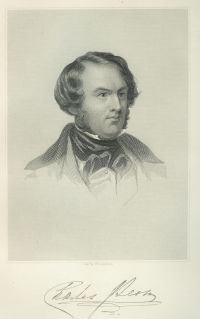 Charles James Lever,
Davenport Dunn, a Man of Our Day…
Charles James Lever,
Davenport Dunn, a Man of Our Day…
“ Conway took his cigar from his lips, and while his cheek burned, he seemed about to reply; then, resuming his smoking, he lay back and said nothing. “After all,” said Clowes, “there must be distinctions of rank. One regrets, one deplores, but can't help it Look at all the attempts at equality, and see their failures. No, sir, you have your place in the social scale, and I have mine.” Now, when Mr. Clowes had enunciated this sentiment, he seemed suddenly to be struck by its severity; for he added, “Not but that every man is respectable in his own rank ”
Norman Moore, Dictionary of National Biography… (1887)
“ After this war Clowes returned to London, and on 18 July 1588 was admitted an assistant on the court of the Barber-Surgeons' Company, and immediately after served in the fleet which defeated the Spanish Armada. He kept his military surgical chest by him, with the bear and ragged staff of his old commander on the lid, but was never called to serve in war again, and after being appointed surgeon to the queen, and spending several years in successful practice in London, retired to a country house at Plaistow in Essex, whence he dates his last preface. ”
Theodore Compton, The Life and Correspondence of the Reverend John Clowes (1882)
“ More than forty years passed without any further progress being made towards a complete Life of this excellent man. Meanwhile the manuscript came into my possession, as well as Mr Clowes’s original letters to Mr Tulk, Mr Harrison, and others. Though I never had the advantage of seeing Mr Clowes, his writings have been, under Divine Providence, the principal means of my own happiness, and I esteem it a high privilege indeed to be enabled to take a humble part in bringing their pious and enlightened author before a younger generation. ”
“ The unconscious Mrs. Driver opened the door, and then with a wild scream fell back before the emerging form of Mr. Bodfish into the arms of Mrs. Clowes. The glass of Mr. Negget smashed on the floor, and the farmer himself, with every appearance of astonishment, stared at the apparition open-mouthed."Mr.—Bodfish!" he said at length, slowly.Mr. Bodfish, incapable of speech, glared at him ferociously."Leave him alone," said Mrs. Clowes, who was ministering to her friend. "Can't you see the man's upset at frightening her? She's coming round, Mr. Bodfish; don't be alarmed." ”
Florence Warden, The house on the marsh (1884)
“ Clowes. Don’t all jump upon me at once when I want to make an impression. Could Miss Christie be safer than with me?” Everybody glanced rather mischievously at Mrs. Clowes; and I saw a faint color rise in her cheeks. “Not with Charlie behind,” said she; and everybody laughed more than ever. I was glad Lady Mills would not let me go, though, for I did not care much about the gentleman they called “Tom,” and Laurence did not like him either. It was about seven miles from Geldham to Denham Court. The drive seemed to me beautiful, though the country was flat ”
Charles James Lever,
Davenport Dunn, a Man of Our Day…
“ Clowes called out in a deep voice,— “Mr. Annesley Beecher and Captain Davis;” and flung wide the door for them to pass out. “Why did you say that to him, Grog?” whispered Beecher, as they moved along. “Just because I was watching the way he looked at me. He had a hardy, bold expression on his face that showed he needed a reminder, and so I gave him one. Always have the first blow when you see a fellow means to strike you.” ”
1911 Encyclopædia Britannica (1911)
“ Clowes, who, in spite of his revivalist sympathies, was more attached to Methodism than Bourne, was cut off from his church for taking part in camp-meetings at Ramsor in 1808 and 1810. His personality drew a number of strong men after him, and a society meeting held in a kitchen and then in a warehouse became the nucleus of a circuit, a chapel being built at Tunstall in July 1811, two months after the fusion of the Bourne and Clowes forces. ”
 Mrs. G. Linnaeus Banks,
The Manchester Man
Mrs. G. Linnaeus Banks,
The Manchester Man
“ Clowes called him back, put a large paper parcel in his hand, and said,“Here, Jotty, see you give these sweetmeats to your cry-a-babby, and tell him an old woman says there’s no harm in fighting in self-defence with any kind of a snake, or for his own good name, or to protect the helpless; but, if he fights just to show off his own bravery, he’s a coward. And you tell him from me never to be ashamed of tears he has shed in repentance for injury he may have done to any living thing. Now see you tell him, parson ”
 Arnold Bennett,
The Matador of the Five Towns and Other Stories
Arnold Bennett,
The Matador of the Five Towns and Other Stories
“ However, Mr Rannoch's mouth happily did not catch the eye of the second.The second was a visitor beyond Mr Cowlishaw's hopes, no other than Mrs Simeon Clowes, landlady of the Turk's Head and Mayoress of Hanbridge; a tall and well-built, handsome, downright woman, of something more than fifty and something less than sixty; the mother of five married daughters, the aunt of fourteen nephews and nieces, the grandam of seven, or it might be eight, assorted babies; in short, a lady of vast influence. ”
Charles James Lever,
Davenport Dunn, a Man of Our Day…
“ They would have a fight. They said we wanted something to get cotton-spinning out of our blood; and, egad! I suspect they've got it. “Our views,” continued Clowes, pompously, “were either a peace or a march to St. Petersburg. This French alliance is a rotten thing, sir. That Corsican will double on us. The very first moment any turn of fortune gives France an advantage, he 'll make peace, and leave us all the obloquy of a reluctant assent. That's his view,—that's mine, too; and we are seldom mistaken.” “For all that, I wish I were back there again,” said Conway. ”
Norman Moore, Dictionary of National Biography… (1899)
“ He alludes to his possession of the ‘Surgery’ of Guido and of Vigo, and of other books, but mentions no work by himself. ‘A profitable treatise of the Anatomie of Man's Body,’ of which the earliest extant edition is of 1577, is stated on the title-page to have been compiled by him. It is dedicated to Sir Rouland Haiwarde, the president, and the governors, by William Clowes (1540–1601) [q. v.] ”
Charles James Lever,
Davenport Dunn, a Man of Our Day…
“ Conway's eyes opened widely as he stared at him, and he puffed his cigar a little more energetically, but never spoke. “You 've done with the service, I suppose?” said Clowes, after a while. “I'm afraid so,” said Conway, sighing. “Well, he”—and he jerked his thumb towards Dunn's room—“he is the man to help you to something snug. He can give away places every hour of the day. Ay, sir,” said he, warming, “he can make anything, from an archbishop to a barony constable.” ”
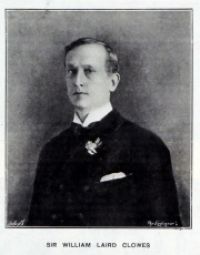 William Laird Clowes,
The Royal Navy, a History from the Earliest Times to the Present…
(1890s)
William Laird Clowes,
The Royal Navy, a History from the Earliest Times to the Present…
(1890s)
“ Thomas Howard Earl of Surrey, 3rd Duke of Norfolk. The Royal Navy A History From the Earliest Times to the Present By Wm. Laird Clowes Fellow of King's College, London; Gold Medallist U.S. Naval Institute; Hon. Member of the R.U.S. Institution ”
 P. G. Wodehouse,
Mike
(1919)
P. G. Wodehouse,
Mike
(1919)
“ There are stories about me which only my brother knows. Did I want them spread about the school? No, laddie, I did not. Hence, we see my brother two terms ago, packing up his little box, and tooling off to Rugby. And here am I at Wrykyn, with an unstained reputation, loved by all who know me, revered by all who don't; courted by boys, fawned upon by masters. People's faces brighten when I throw them a nod. If I frown——" "Oh, come on," said Trevor. Bread and jam and cake monopolised Clowes's attention for the next quarter of an hour. ”
W. Laird Clowes, The Royal Navy, a History from the Earliest Times to the Present (1897)
“ Again, when Cunobelinus, or Cymbeline, reigned at Camulodunum, and Caligula was Emperor, a Roman invasion appeared to be imminent; but the insane vanity of Caligula was contented with a theatrical and ridiculous demonstration on the opposite coasts; [8] and not until the time of Claudius, in A.D. 43, was any step taken towards an effective conquest of Britain. ”
“ I've seen Mis Starkey take her biscuits out many a time,—as nice a brown as ever you'd want; and the chimney don't smoke a mite. They kep' a wood fire here in May most all the time, so I know."Clover thought the matter over for a day or two, consulted with Dr. Hope, and finally decided to try the experiment. No. 13 was taken, and Mrs. Kenny engaged for two days' work each week, with such other occasional assistance as Clover might require. She was a widow, it seemed, with one son, who, being employed on the railroad, only came home for the nights. ”
W. Laird Clowes, The Royal Navy, a History from the Earliest Times to the Present (1897)
“ Powel in his history of Wales. [16] According to him, Madog sought adventures by sea, sailing west, and leaving the coast of Ireland to the north. He saw many strange things in an unknown land, at which in the course of time he arrived. [17] This land "must needs be some part of Nova Hispania or Florida. Whereupon it is manifest that that country was long before by Brytaines discovered, afore either Columbus or Americus Vesputius led anie Spaniardes thither." Though the common folks have added much that is fabulous, "sure it is that there he [Madoc] was." ”
“ There's one poor fellow in a reclining-chair who looks badly.""That's the one whose room Mrs. Watson has marked for her own. She asks him three times a day how he feels, with all the solicitude of a mother," said Phil."Who's Mrs. Watson?""Well, she's an old lady who is somehow fastened to us, and who considers herself our chaperone," replied Clover, with a little laugh. "I must introduce you by-and-by, but first we want a good talk all by ourselves. Now tell us why you haven't come to see us before. We have been hoping for you every day." ”
“ Watson's spirits a little, and Clover left her in the parlor, exchanging experiences and discussing symptoms with some ladies who had sat opposite them at table. Mrs. Hope came for a call; a pretty little woman, as friendly and kind as her husband. Then Clover and Phil went out for a stroll about the town. Their wonder increased at every turn; that a place so well equipped and complete in its appointments could have been created out of nothing in fifteen years was a marvel! ”
“ My wife is coming to see you as soon as you have had your dinner and got settled a little. She sent those to you," indicating a vase on the table, filled with flowers. They were of a sort which Clover had never seen before,—deep cup-shaped blossoms of beautiful pale purple and white."Oh, what are they?" she called after the doctor."Anemones," he answered, and was gone."What a dear, nice, kind man!" cried Clover. "Isn't it delightful to have a friend right off who knows papa, and does things for us because we are papa's children? You like him, don't you, Phil; and don't you like your room?" ”
“ I thought you looked upon me as a sort of mother or older sister.""Only fifteen months older," retorted Clarence. "I never heard of any one's being a mother at that age. I'm a man now, I would have you remember, though I am a little younger than you, and know my own mind as well as if I were fifty. Dear Clovy," coaxingly, "couldn't you? You liked the High Valley, didn't you? I'd do anything possible to make it nice and pleasant for you.""I do like the High Valley very much," said Clover, still with the feeling that Clarence must be half in joke, or she half in dream. ”
W. Laird Clowes, The Royal Navy, a History from the Earliest Times to the Present (1897)
“ The white-robed priests waving banners, chanting, and carrying with them bells and books to these far distant shores, have shared the common fate of the bulk of mankind and vanished without leaving a trace of their name or race in Ireland the Great. ”
W. Laird Clowes, The Royal Navy, a History from the Earliest Times to the Present (1897)
“ In the thirteenth century all sea warfare, whether regular or irregular, was conducted by people who were little better than "a horde of sanctioned robbers"; and one is not surprised, therefore, to discover, as one often does when studying the early history of England, that in war time ships were fitted out by individuals as well as by governments to prey upon the enemies of the country. ”
“ You come next to Phil and Dorry with me.""Hang Phil and Dorry! Who wants to come next to them? I want you to like me a great deal more than that. I want you to love me. Couldn't you, Clover?""How strangely you talk! I do love you, of course. You're my cousin.""I don't care to be loved 'of course.' I want to be loved for myself. Clover, you know what I mean; you must know. I can afford to marry now; won't you stay in Colorado and be my wife?""I don't think you know what you are saying, Clarence. I'm older than you are. ”
various contributors, Punch, Volume 147 — July 15th, 1914… (19th and 20th century)
“ In the art of introducing bears into the boudoir of a countess or pigs into the study of a diplomat, and then clinching the matter with the wittiest of epigrams, Clovis is supreme. He knows, too, an immense amount about the vengeance that children may take upon their relations, and ladies upon their lady friends. I like him especially when he manoeuvres some stupid but kind-hearted woman into a situation of whose peril she herself is only cloudily aware, while the reader knows all about it. That is the fun of the whole thing. The reader is for ever assisting Clovis and Reginald ”
W. Laird Clowes, The Royal Navy, a History from the Earliest Times to the Present (1897)
“ There are traces of Madoc traditions—though not such tradition s we find in Powel—in Meredydd. Coupling these with the statement that Madoc went across the broad sea, or "Morwerydd," it becomes highly probable that Madoc's voyage was only to Ireland. In early Welsh, "Morwerydd" regularly means the Irish Sea, and not the Atlantic. In the Brut y Tywysogion, we are told that Owain Gwynedd married an Irish lady. Another early Welsh writer couples Riryd, Madoc's brother, with Irish estates, and Riryd is found in the stories sailing with Madoc to America. ”
W. Laird Clowes, The Royal Navy, a History from the Earliest Times to the Present (1897)
“ If the Britons had any ships and seamen beyond those destroyed on the coast of Gaul, they had at least no union, no common aims, no central authority strong enough to wield effectively the naval arm. The country was broken up into petty principalities and chieftainships, and while little co-operation between the jealousies and hatreds of rivals was possible on shore, none at all was to be expected at sea, where only from co-operation, guided by authority, can success be hoped for, even amid the most favourable circumstances. ”
Charles Morris, Historic Tales: The Romance of Reality…
“ Aridius thereupon sought Clovis, in the guise of a deserter from Gondebaud. But such was his intelligence, the charm of his conversation, the wisdom and good judgment of his counsel, that Clovis was greatly taken with him, and yielded to his advice."You gain nothing by ravaging the fields, cutting down the vines, and destroying the harvests of your adversary," he said, "while he defies you in his stronghold. Rather send him deputies, and lay on him a tribute to be paid you every year. Thus the land will be preserved, and you be lord forever over him who owes you tribute. ”
