“ She is to enjoy every indulgence suited to her rank, if it is not inconsistent with her safety.” Much puzzled, Maurice conveyed the desired assurance to Eirene, who took in its significance at once, and inquired sharply how he was to be treated, in reply to which the monk declared that he would be the guest of the monastery. Satisfied with this answer, Eirene asked to be shown her room, to which she and Zoe were conducted by one of the officials of the monastery and the two old women. ”
Eirene
Definition and stakes
The theme of “Eirene” has been addressed by authors such as Sydney C. Grier, Charlotte M. Yonge and Louis Joseph Vance. It is often associated with terms like Zoe, Irene, king, Éire and church.
Quotes about “Eirene”
“ As I came here, Madame Ladoguin, the wife of our Consul-General at Therma, begged me to place her house and her services at your disposal for as long as you required them. She is a charming and accomplished woman, and her society will cheer and refresh you.” “Very well,” said Eirene, rising. “I hardly dare indulge hope for the future, after what I have suffered to-day. You will pardon me if I leave you now, monsieur. I can endure no more.” ”
“ The Grand Seignior will insist on managing everything himself, and of course he can’t do more than a certain amount, and so business gets into frightful arrears all over the empire.” “I don’t care,” said Eirene stubbornly. “I shall trust no one; that is the lesson life has taught me. The ruler’s eye will be everywhere, the ruler’s hand always ready.” “Maternal or elder-sisterly government,” muttered Maurice. “Well, Eirene, have it your own way, and go ahead, and Zoe and I will come and preach revolution to your people. What would you do to us?” ”
“ When it had been despatched, she and Eirene looked at one another rather anxiously. It was undeniable that their appearance was not distinguished. A badly fitting blouse, a home-made skirt, moccasins instead of shoes, and a paucity of hairpins—for none had been obtainable in the village—are drawbacks which only beauty of a very exceptional order can successfully surmount. “I shouldn’t mind a bit, if it wasn’t that we want to look so particularly dignified,” said Zoe. “Suppose you put on the famous girdle, Eirene. That ought to make an impression.” ”
“ Curiously enough, the danger attending both the means of communication she had contemplated was made clear to her on the same day. She was well supplied with money, and had been occupied in the very necessary task of getting some new clothes. One of her orders had been sent to a British firm in Vindobona. It was written in Eirene’s name by Madame Ladoguin, who acted as a kind of unofficial lady-in-waiting, but it chanced that she was called out of the room before it was finished, and Eirene addressed and fastened the envelope in a hurry, in order to catch the post. ”
“ Why, Eirene, the brigands wouldn’t do anything that they thought would make the saints angry, and they belong to the Greek Church just as much as you do.” “They? They are miserable schismatics—followers of the upstart heretical church of Thracia, outcasts from Orthodoxy!” cried Eirene. “Oh, do be quiet!” cried Zoe anxiously. “That new man whom Milosch brought with him to-day may understand English. I saw him staring hard at you when you were kissing all those old worn-out saints on the screen.” “But what harm could it do if he did? These men know that they are schismatics.” ”
 Charlotte M. Yonge,
History of Christian names
(1884)
Charlotte M. Yonge,
History of Christian names
(1884)
“ It is extremely common in the Eastern Church, and especially in Russia, where the first letter suffers the usual change into V. The feminine, Basilia, is still in use among the modern Greeks, and once even seems to have been known among English ladies, since the sister of Earl Strongbow is thus recorded in history, but its use has died away amongst us. Section VIII.—Irene. In heathen days Εἰρήνη (Eirene) , peace, was personified and adored as a goddess; in Christian times, when peace on earth was preached, it was formed into a name—that which we know as Irene. ”
“ It seems to have been a Scythian emissary who arranged for our being brought here, on the pretext that Eirene’s life was in danger outside. At least, that was what they told him, but I should say that the Thracian party knew something more. At any rate, I have some hope of getting him to let us go if we are left alone long enough. ”
 Louis Joseph Vance,
Terence O'Rourke
(1905)
Louis Joseph Vance,
Terence O'Rourke
(1905)
“ The Eirene plowed on toward the coast; gradually it loomed before her bows until its outlines were easily to be discerned with the unaided eye—a long, low border of shelving beach that was tossed back from the sea in yellow sand hills, irregular, studded with clumps of stunted grass: hills that stretched away inland to the eastern horizon in a broken perspective of rounded forms, sweltering beneath the sky of brass and its unblinking sun, lonely, desolate and barren—a monstrous bald place upon the poll of the earth. Not a sign of life was there; naught but sand and silence and the sun. ”
“ Therefore I naturally feel an interest in getting to know what they are.” “And what are they, Maurice?” asked Zoe. “I thought these men all came from Thracia or Dardania.” “No, they are nearly all Illyrians—the Christian kind, such as it is. They are Emathians born, though they are under foreign direction; there’s no doubt of that. And very few of them seem to have become brigands for the fun of the thing. Most of them are pretty sick of the life, but they have made their own villages too hot to hold them.” “But that was their own fault,” objected Eirene. ”
Charles Morris, Historic Tales: The Romance of Reality…
“ Their leader, Leif by name, was the son of Eirek the Red, the discoverer of Greenland, and a Viking as fierce as ever breathed the air of the north land. Outlawed in Norway, where in hot blood he had killed more men than the law could condone, Eirek had made his way to Iceland. Here his fierce temper led him again to murder, and flight once more became necessary. Manning a ship, he set sail boldly to the west, and in the year 982 reached a land on which the eye of European had never before gazed. ”
 Georg Ebers,
The Sisters — Volume 3
Georg Ebers,
The Sisters — Volume 3
“ Do you know that Eros has pierced my heart, and that I burn for the fair Irene, although these eyes have not yet been blessed with the sight of her?"I see you believe me, and I am speaking the exact truth, for I vow I will possess myself of this infantine Hebe as surely as I hope to win my brother's throne; but when I plant a tree, it is not merely to ornament my garden but to get some use of it. You will see how I will win over both the prettiest of little lady-loves and the high-priest who, to be sure, is a Greek, but still a man hard to bend. ”
T. F. Young, Canada and Other Poems
“ Or by the turf fire, upon Erin's old sod, Each Irishman, kneeling in humble devotion, Would love all his brothers, while praying to God.Oh Erin, mavourneen! Let Love's joyous fingers Strike out from your harps, one glad, resonant strain, And, if one discordant, harsh, jarring note lingers, Oh, strike for your country, together again! And then, when your hands and your hearts are united, When you kneel at one shrine, when you bow to one law. With a sea of glad brightness, your isle shall be lighted, While thunders the chorus, of Erin-go-bragh. ”
 Andrew Lang,
The Orange Fairy Book
Andrew Lang,
The Orange Fairy Book
“ After this, one half of the men of the land of Lochlann did homage to Oireal, and the other half to Iarlaid. And they governed their kingdoms as they would, and in a few years they became grown men with beards on their chins; and Iarlaid married the daughter of the king of Greece, and Oireal the daughter of the king of Orkney. The next year sons were born to Oireal and Iarlaid; and the son of Oireal was big and strong, but the son of Iarlaid was little and weak, and each had six foster brothers who went everywhere with the princes. ”
William Young Sellar, Terrot Reaveley Glover, and Margaret Bryant, 1911 Encyclopædia Britannica (1911)
“ The personages of the action are prominent in poetry and legend, or by their ethnical names stir the sentiment of national enthusiasm—Aeneas and Anchises, Dido, Acestes, Evander, Turnus. The spheres of activity in which they are engaged are war and sea adventure. The passion of love is a powerful addition to the older sources of interest. The Aeneid revives, by a conventional compromise between the present and the remote past, some image of the old romance of Greece; it creates the romance of “that Italy for which Camilla the virgin, Euryalus, and Turnus and Nisus died of wounds.” ”
Charlotte M. Yonge,
History of Christian names
(1884)
“ An ancient Erik was said to have been admitted among the gods, and Earic was the second name of Æsc, the son of Henghist; but it was the northern people who really used Eirik, which comes over and over in the line of succession of all the Northern sovereignties, figures in their ballads, and, in the person of King Eirik Blödaxe, is connected with their finest poetry. In the present day it is scarcely less popular than in old times, and has the feminine Eirika. ”
S. Baring-Gould, Curious Myths of the Middle Ages
“ Eirek was a son of Thrand, king of Drontheim, and having taken upon him a vow to explore the Deathless Land, he went to Denmark, where he picked up a friend of the same name as himself. They then went to Constantinople, and called upon the Emperor, who held a long conversation with them, which is duly reported, relative to the truths of Christianity and the site of the Deathless Land, which, he assures them, is nothing more nor less than Paradise. ”
 Padraic Colum,
The King of Ireland's Son
Padraic Colum,
The King of Ireland's Son
“ A thousand Fields and her own fields small, small! “What a fine and wide place is Eirinn,” said she, “I am Mor, but not great after all.” Then a herdsman came, and he told her That her sons had stolen away: They had left the calves in the hollow, With the goose-flock they would not stay: They had seen three ships on the sea And nothing would do them but go: Mor wept and wept when she heard it, And her tears made runnels below. ”
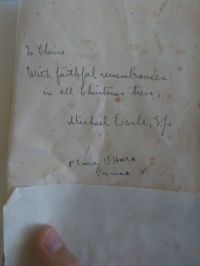 Michael Earls,
Ballads of Peace in War
Michael Earls,
Ballads of Peace in War
“ Faith, and near the mountains and the sunny lakes and brooks it is, Like the olden seanichies, the pair of us belong. Far and broad our journeyin', up and down the land we go, Today among the mountains and tomorrow by the sea; Pleasant are the roads with us, and to a welcome grand we go, Erin wins the heart of you, whoever you may be. Erin's heart will capture you, if you will but listen now, Great she was afore the Danes and all her Saxon foes, After that the sorrows came, sure your eyes will glisten now, Up, my lad, and sing for them "The Dark Little Rose." ”
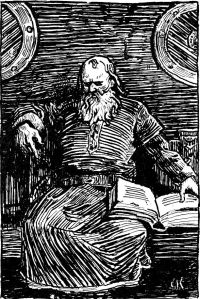 Snorri Sturluson,
Heimskringla — Harald Harfager's Saga Saga
Snorri Sturluson,
Heimskringla — Harald Harfager's Saga Saga
“ Then King Eirik went through Viken, and subdued it, and remained far into summer. Gudrod and Trygve fled to the Uplands. Eirik was a stout handsome man, strong, and very manly, -- a great and fortunate man of war; but bad-minded, gruff, unfriendly, and silent. Gunhild, his wife, was the most beautiful of women, -- clever, with much knowledge, and lively; but a very false person, and very cruel in disposition. The children of King Eirik and Gunhild were, Gamle, the oldest; then Guthorm, Harald, Ragnfrod, Ragnhild, Erling, Gudrod, and Sigurd Sleva. ”
Irenaeus, Ante-Nicene Fathers Vol. I — Against Heresies… (1885)
“ But the Holy Spirit [26] taught them to give thanks on being all rendered equal among themselves, and led them to a state of true repose. Thus, then, they tell us that the Æons were constituted equal to each other in form and sentiment, so that all became as Nous, and Logos, and Anthropos, and Christus. The female Æons, too, became all as Aletheia, and Zoe, and Spiritus, and Ecclesia. Everything, then, being thus established, and brought into a state of perfect rest, they next tell us that these beings sang praises with great joy to the Propator, who himself shared in the abounding exaltation. ”
 Eleanor Hull,
The Northmen in Britain
(1913)
Eleanor Hull,
The Northmen in Britain
(1913)
“ Eirik entered Sweyn Fork-beard’s service and married his daughter in 996; he spent his time in cruising and harrying, until he joined Sweyn in his wars against Olaf; and after Olaf’s disappearance at the battle of Svold Earl Eirik became owner of his war-vessel the Long Serpent, and of great booty besides. He and Sweyn and the Swedish King divided Norway between them, and Eirik got a large share and the title of earl, and he allowed himself to be baptized. ”
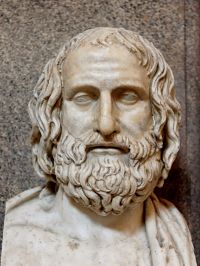 Euripides,
The Tragedies of Euripides, Volume I
Euripides,
The Tragedies of Euripides, Volume I
“ Menelaus, cease from thy irritated state of mind; I Phœbus the son of Latona, in thy presence, am addressing thee. Thou too, Orestes, who standest over that damsel with thy sword drawn, that thou mayest know what commands I bring with me. Helen indeed, whom thou minded to destroy, working Menelaus to anger, didst fail of thy purpose, she is here, whom ye see wrapt in the bosom of the sky, preserved, and not slain by thy hands. Her I preserved, and snatched from thy sword, commanded by my father Jove. For being the daughter of Jove, it is right that she should live immortal. ”
 Norah M. Holland,
Spun-yarn and Spindrift
Norah M. Holland,
Spun-yarn and Spindrift
“ A SONG OF ERIN Far to westward in the sunset tall and bare her cliffs arise, Mother Erin, with the tender love and laughter in her eyes, Looking out across the waters, dreaming of her argosies. Argosies that sail forever, laden down with hopes and fears, Ships of dream, returning never, though she waits throughout the years, Waits, with eyes wherein the laughter grows more sorrowful than tears. One by one her children leave her—stalwart sons and daughters fair, Straining eyes grown dim with anguish as her hilltops melt in air ”
 Jeremiah Curtin,
Myths and Folk-Lore of Ireland
(1911)
Jeremiah Curtin,
Myths and Folk-Lore of Ireland
(1911)
“ THE SON OF THE KING OF ERIN AND THE GIANT OF LOCH LÉIN. [1] On a time there lived a king and a queen in Erin, and they had an only son. They were very careful and fond of this son; whatever he asked for was granted, and what he wanted he had. When grown to be almost a young man the son went away one day to the hills to hunt. He could find no game,—saw nothing all day. Towards evening he sat down on a hillside to rest, but soon stood up again and started to go home empty-handed. Then he heard a whistle behind him, and turning, saw a giant hurrying down the hill. ”

“ On guard at the gate was Nisus son of Hyrtacus, most valiant in arms, whom Ida the huntress had sent in Aeneas' company with fleet javelin and light arrows; and by his side Euryalus, fairest of all the Aeneadae and the wearers of Trojan arms, showing on his unshaven boy's face the first bloom of youth. These two were one in affection, and charged in battle together; now likewise their common guard kept the gate. Nisus cries: 'Lend the gods this fervour to the soul, Euryalus? or does fatal passion become a proper god to each? ”
Michael Clarke, Story of Aeneas
“ Great in her charms, as when on gods above She looks, and breathes herself into their love. DRYDEN, AEneid, BOOK II.Taking the hero by the hand as he was in the act of raising his sword to strike Helen, the goddess thus rebuked him: "What is it that excites your anger now, my son? Where is your regard for me? Have you forgotten your father Anchises and your wife and little son? They would have been killed by the Greeks if I had not cared for them and saved them. It is not Helen or Paris that has laid low this great city of Troy, but the wrath of the gods. ”
Irenaeus, Ante-Nicene Fathers Vol. I — Against Heresies… (1885)
“ But there rushed forth in advance of the rest that Æon who was much the latest of them, and was the youngest of the Duodecad which sprang from Anthropos and Ecclesia, namely Sophia, and suffered passion apart from the embrace of her consort Theletos. This passion, indeed, first arose among those who were connected with Nous and Aletheia, but passed as by contagion to this degenerate Æon, who acted under a pretence of love, but was in reality influenced by temerity, because she had not, like Nous, enjoyed communion with the perfect Father. ”
Georg Ebers,
The Sisters — Complete
“ Since seeing the murderers every thought of revenge, every wish to punish the seducer with death, had vanished from her mind; one desire alone possessed her now—that of rescuing him, the man, from the clutches of these ravening beasts. Walking slowly onwards she repeated to herself every word she had heard that referred to Publius and Irene as spoken by Euergetes, Eulaeus, the recluse, and the assassins, and recalled every step she had taken since she left the temple ”
